
Penn State Researchers Control Nanomotors Inside Living Cells For The First Time
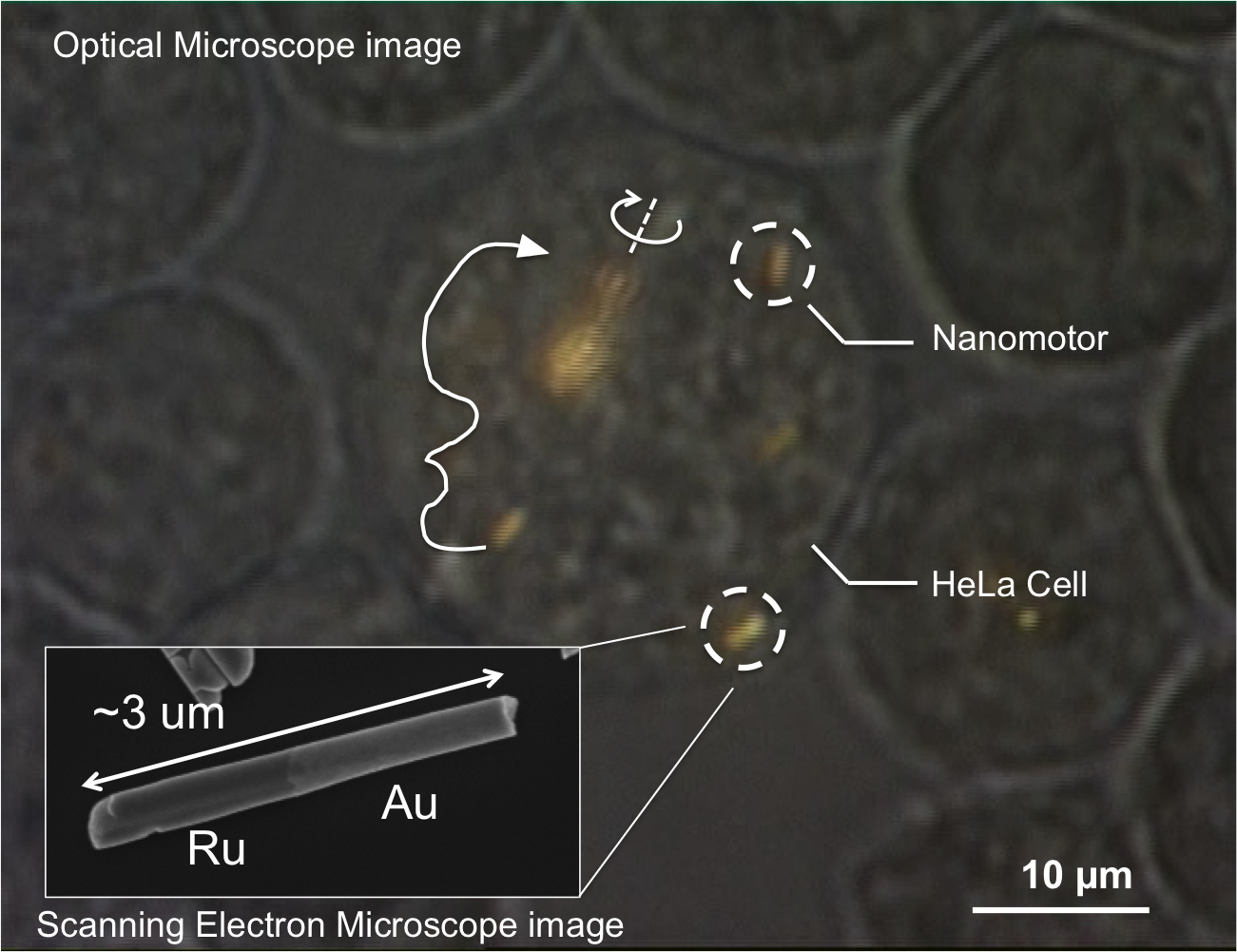
Penn State researchers in the fields of chemistry and engineering have successfully developed the first nanomotors capable of being controlled inside living human cells.
These nanomotors are essentially synthetic, rocket-shaped metal particles that convert chemical energy into motion and use ultrasonic waves and magnetism to navigate around within cells.
Tom Mallouk, Evan Pugh Professor of Materials Chemistry and Physics, can attest to the never-ending possibilities of this new medical marvel because he first developed the nanomotors at Penn State ten years ago with chemist Ayusman Sen and physicist Vincent Crespi.
“As these nanomotors move around and bump into structures inside the cells, the live cells show internal mechanical responses that no one has seen before,” Mallouk said. “This research is a vivid demonstration that it may be possible to use synthetic nanomotors to study cell biology in new ways. We might be able to use nanomotors to treat cancer and other diseases by mechanically manipulating cells from the inside.”
In the video below, we see the nanomotors infiltrate cervical cancer cells and bounce about in the cell tissue.
Other Penn State researchers involved in the discovery include Wei Wang, Sixing Li, Suzanne Ahmed, and Tony Jun Huang. Together, Mallouk and his team hope that this discovery has a drastic effect on the future of modern medicine as they further comprehend the numerous ways to properly utilize the nanomotors.
“One dream application of ours is Fantastic Voyage-style medicine, where nanomotors would cruise around inside the body, communicating with each other and performing various kinds of diagnoses and therapy,” Mallouk said. “There are lots of applications for controlling particles on this small scale, and understanding how it works is what’s driving us.”
Your ad blocker is on.
Please choose an option below.
Purchase a Subscription!
About the Author


Former Penn State Fullback Stephen Smith ‘Pinching Myself’ Over State College Return Through Pickleball
The Picklr State College celebrated its grand opening on October 3.

Your Penn State Football Bye Week Rooting Guide
There’s still football on this weekend, even if it’s not Penn State!

State College History Lesson: The Disappearance of Jennifer Cahill
Jennifer Cahill was last seen near North Atherton Street in 2014. She hasn’t been heard from since.

Being and Becoming: Leo Dillinger’s Senior Column
Leo Dillinger reflects on his time spent as a Penn State student.