
Cael Sanderson Pleads For ‘Common Sense’ After Big Ten Reveals Pre-Seeds Ahead Of Conference Tournament
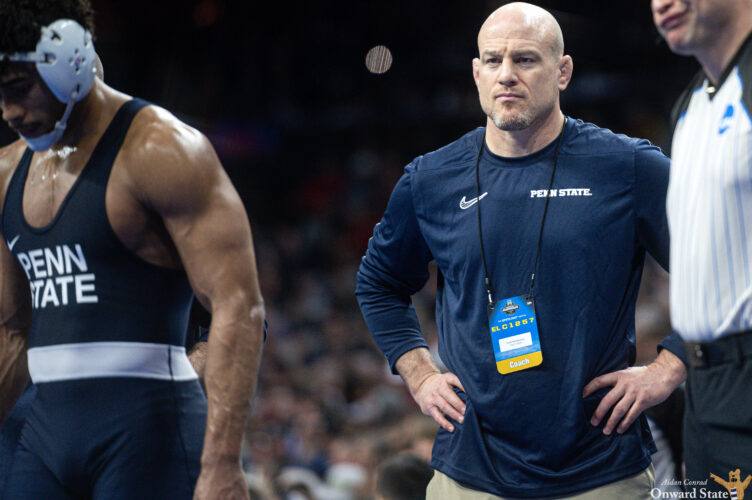
When it comes to coaches, Cael Sanderson is as level-headed as they come.
Whether he’s addressing the media or sitting mat-side watching one of his wrestlers compete, it is rare to see him stray from his stoic demeanor. But after the pre-seeds were released for this weekend’s Big Ten Wrestling Tournament, Sanderson didn’t hold back his thoughts.
“It just doesn’t make sense,” Sanderson told the media on Monday.
This reaction comes particularly after learning that unbeaten Levi Haines is seeded second behind Nebraska’s Christopher Minto, despite his 8-6 win over Minto in Penn State’s January dual meet against the Cornhuskers.
This wasn’t the only weight class that raised eyebrows. At 133 pounds, true freshman Marcus Blaze earned the top seed ahead of defending national champion Lucas Byrd of Illinois. Both wrestlers are undefeated and have yet to meet this season.
With much of the early conversation surrounding the Big Ten Wrestling Championships focused on the controversial pre-seeds, Sanderson, along with many wrestling fans, is left wondering what exactly went wrong with the algorithm.
“In the past, our coaches spent a lot of time seeding the tournament and the bracket, so we thought if a third party could do a good job, but obviously, what happened isn’t going to work,” Sanderson said.
For the first time, the Big Ten Conference turned away from its traditional pre-seeding system, in which conference coaches voted to set the bracket. Instead, the conference used WrestleStat’sTournament Seeder Program, a 100-point algorithm designed to rank all 14 starters at each weight. According to WrestleStat AI, the formula distributes points as follows:
Head-to-head results: 25 points
Record against common opponents: 25 points
Conference dual record: 20 points
Quality matches: 10 points
Ratings Percentage Index (RPI): 10 points
Coaches’ Rankings: 5 points
Conference Allocations: 5 points
This system was designed to eliminate any potential bias that may have existed under the previous format. But with the change comes a new appeal process. The day before the tournament, coaches can challenge a seeding if a wrestler is within 15 points of the next closest seed.
Even so, Sanderson isn’t convinced the system will ensure his wrestlers will receive the seeds they have earned.
“I mean, how do you know if it’s going to be within 15 points? Based on the way things came out, they could be anywhere. We haven’t seen a number,” Sanderson said. “You are relying on a system, I think the coaches all thought would be a little bit better than what they came up with, unfortunately.”
For fans and coaches, the frustration doesn’t stop at the rankings themselves. With the Big Ten widely regarded as the nation’s toughest wrestling conference, these seeding inconsistencies could force some marquee matchups into earlier rounds.
Matchups like No. 4-ranked PJ Duke and No. 1-ranked Brandon Cannon of Ohio State could come as early as the second round. A similar situation may unfold at 184 pounds, where No. 1 Rocco Welsh could face No. 2 Angelo Ferrari of Iowa in the second round as well. Typically, these matches would be reserved for the semifinals or finals.
“There needs to be a common-sense application, so we need to figure that out. Stuff just doesn’t make sense,” Sanderson said.
Despite the frustrations, Penn State still has six wrestlers who earned top seeds for this weekend’s tournament. Looking ahead, Sanderson knows that no matter what the final brackets look like, his team will be ready to compete.
“I am not too worried about it. We will figure it out,” Sanderson said. “We just need to do the best that we can to make sure these guys get the seeds they earned throughout the season.”
Your ad blocker is on.
Please choose an option below.
Purchase a Subscription!
About the Author

Penn State Football Lacks An Identity, But It Goes A Lot Deeper Than Matt Campbell
The cardinal sin of the James Franklin era has bled into the Matt Campbell era: Penn State doesn’t know what it wants to be.
Your Guide To Penn State’s 2026 Family Weekend
There are plenty of activities around campus for families to enjoy and spend time with their children.
From Business Owner To Goat Farmer: The Life Of Penn State Wrestler Tyler Kasak Outside The Wrestling Room
“There is no mountain too high and no valley too low for me to accomplish what I want to do.”