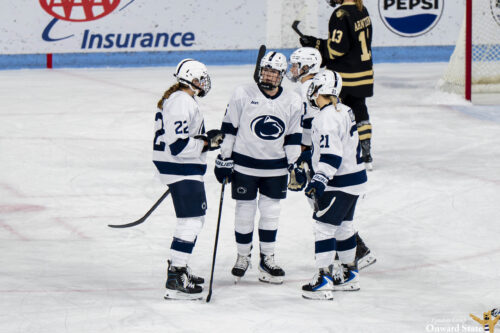
Penn State History Lesson: Each Penn State Football Head Coach’s First Season
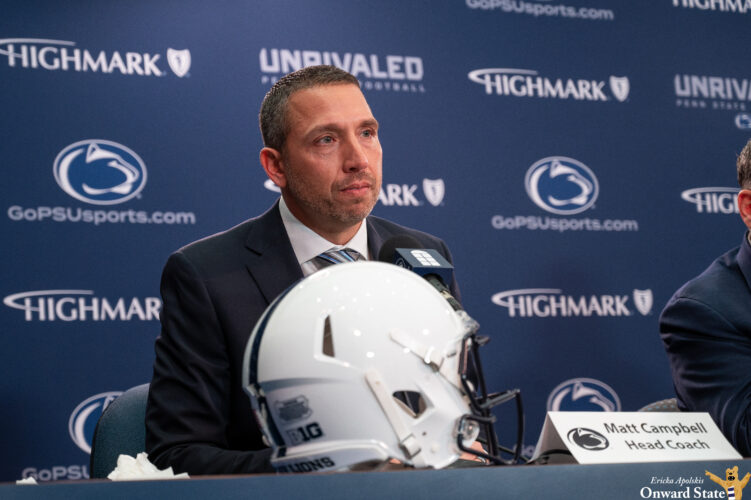
The Matt Campbell era of Penn State football kicks off in a little over two weeks, folks.
The program is shaping up to be a completely new look and feel to what Happy Valley got out of James Franklin for almost 12 years.
As a blueblood college football program, Penn State takes its time to make sure it has its guy when it comes to coaching cycles. Campbell is only the program’s 17th head coach of all time, with much of the program’s history coming under Joe Paterno’s legendary 46-season run. Campbell is only Penn State’s third permanent head coach since Paterno was let go in 2011.
With much excitement around Campbell’s first spin around the block in the Big Ten and Happy Valley, it’s time to take a look back on how the 16 other head coaches’ first seasons turned out for the Nittany Lions.
George W. Hoskins (1892)
Penn State football’s first head coach: George W. Hoskins. Pennsylvania State College — as it was known back in the day — had already started to compete in football before Hoskins’ arrival, but he is the first person to take on a head coaching role.
The squad was captained by center A.C. Read and went 5-1. The team did not play in a single game in which both teams scored. Its biggest win was a 40-0 pummeling over Wyoming Seminary, while its biggest loss was a 20-0 blunder to Penn in the opener. Hoskins’ first season also included an 18-0 shutout over Bucknell on Old Main Lawn.
Samuel B. Newton (1896)
Hoskins left to coach at Pitt as Samuel B. Newton took over the team. Newton rattled off three straight wins in 1896, including a 40-0 win over Gettysburg at Beaver Field in the season opener. Beaver Field held a capacity of 500 and was in the current area of the Osmond and Frear Laboratory buildings.
Disaster soon struck for Newton in his debut season, however.
Penn State lost four consecutive contests to crash into a 3-4 record. Newton and the Nittany Lions particularly stunk it up in the season finale, falling 48-5 to Carlisle Indian Industrial School in Harrisburg, Pennsylvania.
Sam Boyle (1899)
Sam Boyle only served one season as Penn State’s head man in 1899, but it was a bit of a whirlwind.
Like Newton, he opened his Nittany Lion account in dominant fashion, beating Mansfield, Gettysburg, and Army by a combined score of 84-0. The very next game, though? A 0-0 tie against Washington & Jefferson. Absolute cinema.
Boyle and the Nittany Lions only won one game the rest of the year. They were shut out by Princeton and Navy in the following two weeks before entering the win column for the last time in a 15-0 decision over Dickinson.
Penn State ended the season with a celebratory “No Win November”.
It ended the 19th century with four consecutive losses to Bucknell, Yale, Penn, and the Duquesne Country and Athletic Club by a combined score of 158-5.
The Duquesne Country and Athletic Club particularly had Boyle’s number, taking home a 64-5 win in the season finale. That team probably had alignment all the way to the top.
Pop Golden (1900)
The turn of the century should have brought about a (Pop) Golden age for Penn State football, but it didn’t quite turn out that way. Golden led the Nittany Lions to a 4-6-1 showing in his debut season. Penn State started off 2-0 and played a 0-0 tie at Army in its third game. It didn’t let up a single point until its week four 26-0 loss at Princeton.
The Nittany Lions continued to bumble around later in the season, but did have a unique two-game run where they both lost and won by a score of 44-0. They dropped a 10-0 contest to Buffalo in the finale.
Daniel A. Reed (1903)
Golden took a step back on Penn State’s staff and took a job as an assistant coach under Daniel A. Reed, who was another one-and-done head coach. He burst onto the scene with a 60-0 win over Dickinson Seminary (now Lycoming College). He registered another gargantuan win with a 59-0 shutout in October. Reed ended his only season with a 5-3 record. Not too shabby.
Reed’s Penn State coaching career isn’t even the most interesting thing about him, though. He was elected to Congress in 1918 and served New York’s 43rd congressional district from 1919 to 1945.
His conservative and isolationist views throughout and after World War II ranked him low among New Yorkers, but he continued to serve in the 45th and 43rd districts before dying of a heart attack while in office in 1959.
Tom Fennel (1904)
Tom Fennel was the first Penn State head coach to last five seasons in the chair. He took over for Reed ahead of the 1904 season and led the Nittany Lions to a 6-4 record.
Fennel washed off a 6-0 loss to Penn in his debut with a 50-0 shutout of Allegheny in week two. Penn State fell to Yale the next week, but rattled off three straight wins to sit at a comfortable 4-2 heading into the second half.
The Nittany Lions split the rest of the year 2-2, but it still shaped up as a solid season overall.
Bill Hollenback (1909)
Hollenback signaled a new era for Penn State football. 1909 was the debut year for New Beaver Field, which was the Nittany Lions’ last venue before moving into Beaver Stadium in 1960. New Beaver Field was built next to Rec Hall and on the present-day area of the Nittany Lion Inn and Nittany Parking Deck.
Now, Hollenback technically had two different debut years coaching Penn State: 1909 and 1911. Hollenback’s older brother, Jack Hollenback, coached the program for one year in 1910. However, since 1909 was the first year of the Bill Hollenback era, that’s the one that counts.
Hollenback delivered.
Hollenback led Penn State to its first undefeated season since Hoskins’ tenure with a 5-0-2 showing, including a 31-0 win over Grove City College in New Beaver Field’s debut. The Nittany Lions only allowed 11 points through the seven games, beating their competition by a combined score of 166-11. Penn State finished fifth in the Eastern College Football Independents standings as a totally new era began.
Jack Hollenback (1910)
As mentioned before, Jack Hollenback took over for only one season in 1910 while Bill experimented with coaching Missouri (he went 4-2-2 in his sole year with the Tigers). Hollenback did not quite capture the same magic as his brother, however.
The Nittany Lions won three straight games at New Beaver Field to open the season with a combined score of 164-0. They then fell 10-0 away from home to Penn and fought out a 0-0 tie with Villanova at home. Penn State took down St. Bonaventure and Bucknell in dominant fashion in State College, but dropped its season finale 11-0 at Pitt.
Penn State finished the year 5-2-1, which still wasn’t bad and was an improvement to the years before he or his brother arrived, but it basically served as a placeholder until Bill’s return. Bill went 8-0-1 and 8-0 in the following two seasons after Jack’s departure.
Dick Harlow (1915)
Dick Harlow’s three-year stint leading the Nittany Lions started with a five-game win streak out of the gate. Penn State went 7-2 in 1915, but ended the season on a sour note with a 20-0 loss to Pitt away from home in front of 30,000 people. Harlow played for the Nittany Lions in 1910 and 1911 and was an assistant coach under Bill Hollenback from 1912 to 1914.
Hugo Bezdek (1918)
Hugo Bezdek. Interesting fella.
He took over the Penn State mantle after Harlow left the program to enlist in the army. Bezdek and the Nittany Lions played only four games in his debut 1918 season after World War I, and the Spanish influenza pandemic forced them to cancel five games. Much of the established squad left to join the army leading up to the season.
Bezdek led the Nittany Lions to a 1-2-1 record with a 7-6 win over Lehigh, losses to Rutgers and Pitt, and an opening tie against U.S. Naval Base Wissahickon Barracks.
Football wasn’t Bezdek’s only involvement with Penn State. He served as the interim head coach of Penn State basketball in 1919, coached baseball from 1920 to 1930, and served as the school’s athletic director from 1918 to 1936, all while keeping his football head coaching duties until 1929.
Bezdek is also the only Penn State football head coach born outside of the United States. He was born in Prague, in the present-day Czech Republic, on April 1, 1884.
Bob Higgins (1930)
Bob Higgins’ first of 19 seasons ended with a 3-4-2 record for the Nittany Lions. He played his college ball for Penn State and was on Bezdek’s coaching staff for two years before taking over the program.
Higgins and the Nittany Lions won their opening three games and did not end up back in the win column for the remainder of the season. Penn State played two 0-0 ties against Lafayette and Syracuse, respectively, and dropped games against Colgate, Bucknell, Iowa, and Pitt.
Penn State’s 19-0 loss at Iowa was the first-ever meeting between the two programs. They did not play each other again until 1971, when Penn State won 44-14 in Iowa City.
Joe Bedenk (1949)
The last of Penn State’s one-and-done head coaching stints, Joe Bedenk led the program sandwiched between two terms as an assistant coach. He was an assistant coach from 1929 to 1948 after playing three seasons for the blue and white from 1921 to 1923.
Bedenk’s sole year ended in a winning record. The Nittany Lions went 5-4 despite starting the season off 0-2 with ugly losses to Villanova and Army. Bedenk reeled it back in by leading Penn State to two comfortable wins over Boston College and Nebraska at home, but an away trip loss to No. 15 Michigan State killed the momentum.
Penn State took down rivals Syracuse, West Virginia, and Temple in succession before dropping its season and coaching finale under Bedenk, 19-0 to Pitt. What else was new?
Rip Engle (1950)
Good ol’ Rip Engle.
Highly regarded as Penn State’s second-most legendary coach, Engle revolutionized the program and led it through the transition to calling present-day Beaver Stadium home. He took the Penn State job after coaching at Brown for eight years, six of those as head coach.
Engle’s first season in Happy Valley ended in a 5-3-1 effort, but that doesn’t paint the full picture. Engle dropped three consecutive games and tied one after winning his debut over Georgetown. Penn State was 1-3-1 at the start of November and ended the season on a four-game win streak, including a 21-20 nail-biter over Pitt to end the year. It was the Nittany Lions’ first win over the Panthers in three years.
Joe Paterno (1966)
JoePa. The winningest coach in FBS football to this day. His gargantuan 46 seasons at the helm of Penn State are not easy to put into perspective, but it all started with a 15-7 win over Maryland at Beaver Stadium on September 17, 1966.
Paterno and Co. went on to lose to No. 1 Michigan State in his second-ever game as head coach, 42-8. Another 11-0 slip at Army brought Paterno down to 1-2, but he worked his way back to .500 with a win over Boston College at home.
The Nittany Lions then traveled cross-country for a 49-11 loss at No. 4 UCLA at the Los Angeles Memorial Coliseum. Penn State strung together two consecutive wins for the first time of the season over West Virginia and California, but fell to 4-5 with back-to-back losses to Syracuse and No. 5 Georgia Tech.
Paterno salvaged a .500 showing in his first season with a dominant 48-24 win over Pitt, bringing an end to the beginning of Penn State’s most iconic era.
Tom Sherman quarterbacked Penn State with 58 completions for 943 yards and six touchdowns. Bob Campbell led the way on the ground with 482 yards and five touchdowns on 79 rushes.
Bill O’Brien (2012)
After Penn State let Paterno go in the fallout of the Jerry Sandusky scandal, the Board of Trustees felt that New England Patriots offensive coordinator Bill O’Brien was the right choice to lead the program through the tumultuous period. The board was wrong.
O’Brien dropped his first two games as Penn State head coach to Ohio and Virginia, but rattled off five straight wins to counteract it, including a 39-28 Homecoming decision over No. 24 Northwestern on October 6. Penn State fell to No. 9 Ohio State 35-23 and to No. 18 Nebraska 32-23 despite wins over Purdue, Indiana, and eventual conference champion Wisconsin stretching the back half of the season.
O’Brien finished the season 8-4 with a 6-2 Big Ten record. Matt McGloin tossed 270 completions for 3,271 yards and 24 touchdowns. Zach Zwinak rushed for 1,000 yards and six scores, as defensive back Gerald Hodges tallied 8.5 tackles-for-loss, one sack, and two interceptions.
James Franklin (2014)
Last but not least, Penn State’s most recent chapter, James Franklin.
Franklin’s tenure has not aged well in the eyes of the Penn State faithful after a rather messy breakup between him, the administration, and the fans.
There were high highs and low lows, but Franklin did bring Penn State back to national relevance and respect. That all started with a rather difficult 2014 season.
Penn State started 4-0 under Franklin, with his first Big Ten win coming in a 13-10 contest over Rutgers on September 13, which also served as Rutgers’ first Big Ten game. That quick start was immediately washed by a four-game skid to Northwestern, Michigan, No. 13 Ohio State, and Maryland.
Penn State gutted out a 2-2 showing in the remainder of the regular season despite a 34-10 finale loss to No. 10 Michigan State at home. Franklin returned the Nittany Lions to bowl contention after being ineligible through O’Brien’s tenure, and Penn State fought a gritty 31-30 overtime win over Boston College in the Pinstripe Bowl.
The 2014 squad under Franklin produced some of Penn State’s most iconic NFL players, many of whom have stayed in the program through recent years, including Christian Hackenberg, Chris Godwin, DaeSean Hamilton, Grant Haley, Mike Gesicki, Marcus Allen, and Jordan Lucas.
Your ad blocker is on.
Please choose an option below.
Purchase a Subscription!
About the Author

Hundreds Gather Downtown For No Kings: Bank The Vote Demonstration
The event culminated with a march to the State College Municipal Building to encourage early mail-in voting before midterms.
Penn State Football Names Team Captains Against Michigan
Rocco Becht, Anthony Donkoh, Kooper Ebel, and Blaise Sokach-Minnick received the honor.