
Penn State Researchers Awarded $1.5 Million Grant To Study Academic Struggle
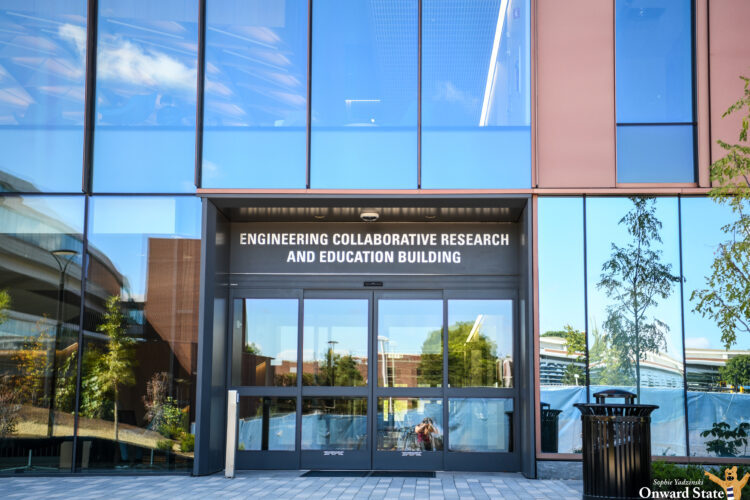
Struggling in class may not always be a bad thing, and Penn State researchers just secured $1.5 million to figure out when it actually helps.
A recent grant awarded to Penn State by the U.S. National Science Foundation (NSF) will provide funds for research measuring the development of high school students’ critical reasoning skills, attempting to distinguish between “productive” and “unproductive” academic struggle.
The project, supported by the NSF’s Collaboratory to Advance Mathematics Education and Learning for K-12 (CAMEL), aims to turn real-world, complex datasets into materials for the classroom and produce a large, AI-ready dataset on how students learn mathematical modeling and how that learning plays out in real classrooms.
According to principal investigator Dr. Rebecca Napolitano, a Penn State associate professor of architectural engineering, high school students will receive real industrial data collected by Penn State labs, including the Two-Dimensional Crystal Consortium, a materials research facility.
By collecting more realistic data from students working through actual classroom problems, researchers hope to better understand what happens when students struggle.
The funds, distributed in increments over three years, will support a study of 4,500 students in algebra and statistics classrooms in seven rural Pennsylvania school districts. Students will have the option whether or not to participate in the study. If they opt in, telemetry software will measure their learning processes by automatically collecting and transmitting information on user activity. The study will track students’ decisions in real time, including how many errors they encounter and how long they pause.
A key goal of the project is to use the data to distinguish “productive” academic struggle from “unproductive” frustration and convey this information to teachers through dashboards.
The multidisciplinary study brings together Penn State faculty from both engineering and education. Co-principal investigators include Wangda Zuo, also a professor of architectural engineering; Kathleen Hill, professor of science education; Xiangquan Yao, associate professor of mathematics education; and Wesley Reinhart, assistant professor of materials science and engineering.
The researchers will work directly with the teachers to shape protocols for analyzing the data.
By the end of the three-year study, the research team hopes to have an AI-ready Student Math Modeling Learning Dataset allowing machine learning tools and educational technology programs to predict whether students’ struggles are productive. Ultimately, the researchers hope the data can help sustain students’ interest in STEM fields rather than disengaging them.
More details on the award are available on the U.S. National Science Foundation’s website.
Your ad blocker is on.
Please choose an option below.
Purchase a Subscription!
About the Author


Penn State BOT Finance Committee Recommends Sale Of Wilkes-Barre Campus For Golf Course
Some academic buildings will be left to Misericordia University.
AT&T To Upgrade Beaver Stadium Cell Service For 2027-28 Season
The upgrade’s goal is to make mobile service more reliable during football games and other events held at Beaver Stadium.

Penn State History Lesson: The Unsolved Murder Of Dana Bailey
Bailey was found dead in her apartment on Allen Street in 1987. Her case has still not been solved.

Penn State Holding Voter Registration & Constitution Day Events
Who wouldn’t want a free cookie with a side of voter registration.