
Penn State History Lesson: Fran Fisher’s Penn State Logo Dream
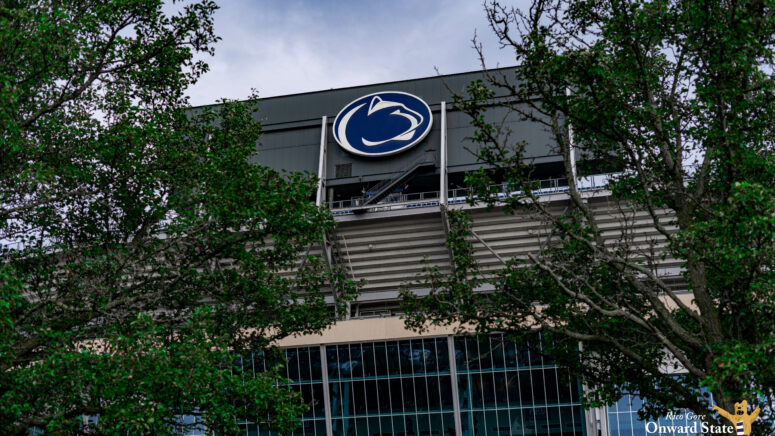
In 1983, the former voice of Penn State football, Fran Fisher, talked with Joe Paterno on an inescapable plane ride about redesigning the Penn State logo, unaware he was about to make Penn State recognizable worldwide with one simple design.
It all started with Fisher sitting in on a licensing committee meeting where they wanted to create a new visual identity for the university, more specifically the Intercollegiate Athletic Department.
The committee wanted a new logo that would work across all 20 campuses, all departments, and the entire university. The committee sought an opportunity to generate revenue by licensing symbols that had never been used before.
An attorney reached out to Fisher to advise Penn State to create its own logo, so Fisher contacted several New York firms. Soon, he found Roy Parcels of Dixon & Parcels Associates.
During a meeting between Paterno, Parcels, and other athletic administrators, they couldn’t agree on what a true Nittany Lion logo should look like.
Around 125 other schools and universities use an animal from the cat family as their mascot, and the goal was to create a lion that looked distinctly different from the others. However, it was difficult to design a logo when nobody knew what a Nittany Lion looked like.
The Nittany Lion is not a real, distinct species; it refers to the mountain lions that once roamed Mount Nittany. Penn State baseball player Harrison “Joe” Mason quickly came up with the name “Nittany Lions” when facing the Princeton Tigers in 1904.
According to “The Nittany Lion: An Illustrated Tale,” written by Jackie Esposito and Steven Herb, when Mason played against Princeton, the Tigers claimed their mascot was the “fiercest beast of them all.”
Mason responded that the Nittany Mountain Lion “has never been beaten in a fair fight.”
When coming up with a face for the Nittany Lion, Paterno said he didn’t “like [the] ones with big teeth and big claws.”
In an interview, Fisher said the committee asked other athletic coaches what feelings they associated with the Nittany Lion. Many of the coaches associated “dignity” and “class” with the mascot, rather than “mean” and “ferocious.”
The Nittany Lion statue, sculpted by Heinz Warneke, inspired the design of the lion’s head and helped finalize the logo.
Along with redesigning the logo, the wordmark was reshaped.
Research showed Penn State students and alumni thought of Penn State as one word, according to a Substack post by Richard Baird. Based on this observation, designers combined the words and capitalized the “S” to still distinguish the two.
Even with the redesigned wordmark, Fisher and the committee intended for Penn State to be recognized only by its right-facing Nittany Lion logo. About a year later, it had succeeded; people across the nation could recognize Penn State pride through the logo. The logo became part of nearly every item associated with the university, including every athletic jersey and classroom at Penn State.
To this day, companies such as Adidas pay for the rights to use the logo. Through its 10-year apparel contract with Adidas, Penn State earns $30 million annually and works with the brand across 31 varsity sports.
Additionally, through consumer merchandise licensing, Penn State generates tens of millions of dollars annually by granting other companies the rights to use the logo.
It’s safe to say Fisher was onto something with his dream of a logo design.
Your ad blocker is on.
Please choose an option below.
Purchase a Subscription!
About the Author


Former Penn State Fullback Stephen Smith ‘Pinching Myself’ Over State College Return Through Pickleball
The Picklr State College celebrated its grand opening on October 3.
Your Penn State Football Bye Week Rooting Guide
There’s still football on this weekend, even if it’s not Penn State!

State College History Lesson: The Disappearance of Jennifer Cahill
Jennifer Cahill was last seen near North Atherton Street in 2014. She hasn’t been heard from since.
Penn State Associate Professor Contributing To $20 Million Bioprinting Project
“Through the project, we hope to engineer an organ that will be a similar size to a real human liver.”