
Penn State Men’s Hockey Goaltender Josh Fleming’s 60-Save Weekend Helps Nittany Lions Earn Three Big Ten Points
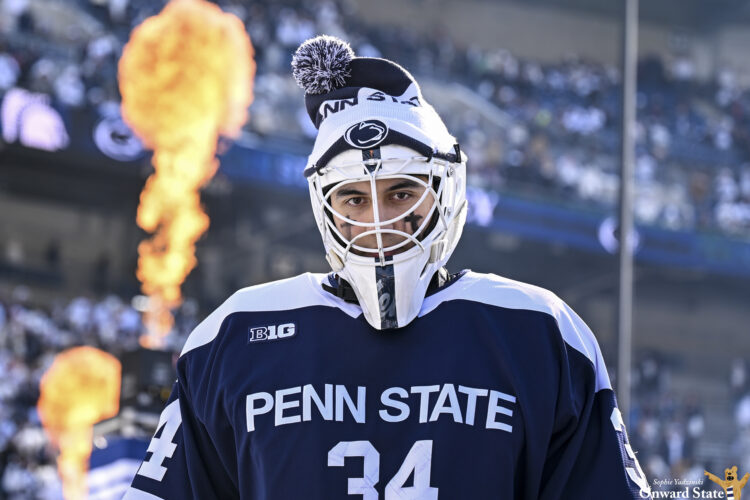
Penn State men’s hockey returned from Minnesota with three Big Ten points and plenty left to fix. Goaltender Josh Fleming, however, is not one of those things.
Fleming stopped 35 of 36 shots Friday before turning away four of Minnesota’s five shootout attempts to help Penn State secure the extra conference point following a 1-1 tie. He added another 25 saves in Saturday’s 4-3 overtime loss, finishing the weekend with 60 saves.
Captain Dane Dowiak didn’t hesitate to credit his netminder.
“He came up big both nights, and I don’t think we would be in the position if he wasn’t in the net,” Dowiak said. “And he gave us a big chance to win both games, no matter what the outcome was at the end.”
Friday’s overtime was a good example of just how impactful Fleming can be. Minnesota put five shots on goal during the extra period. Penn State didn’t register one.
Fleming stopped all five, including a shot from Tanner Ludtke with one second remaining, to get the Nittany Lions to the shootout.
That allowed Dowiak to score the shootout winner in the fifth round, with Fleming only allowing LJ Mooney’s third-round attempt past him.
“I thought Friday night he was just so good, and obviously, he stopped some dangerous shots, many dangerous shots in the game, dangerous shots in overtime, and obviously in the shootout,” head coach Guy Gadowsky said Tuesday. “I mean, I think he absolutely deserved to play again.”
Fleming’s back-to-back starts don’t mean he’s earned the full-time starting role, though.
Gadowsky explicitly said Fleming hasn’t earned that role, but the players in front of him have plenty of confidence in their goaltender.
“He’s unbelievable. Sometimes he makes saves that you can’t really comprehend,” captain Reese Laubach said. “But as a player, you take those. You’re excited about those. We’re super confident playing in front of him. He’s great.”
Fleming also helped Penn State finish the weekend a perfect 6-for-6 on the penalty kill. Gadowsky said the Nittany Lions improved their ability to defend the rush while shorthanded, but credited Fleming for his part in the unit’s success.
The goaltending gave Penn State opportunities. What the Nittany Lions did with those opportunities also offered another sign of progress.
Gadowsky wasn’t happy with Friday’s first period, but the response that followed stood out. Penn State stayed within a goal until Justin Poirier tied the game at 9:03 of the third period.
“We weren’t frantic. We weren’t panicked, and they just kept on pressing,” Gadowsky said. “You see the comeback, you see them keep pressing. They were working, they were managing emotions, and to see it go in was great.”
For a team still trying to get on the same page, that matters. Gadowsky has repeatedly pointed out that half the roster is new, and he acknowledged the chemistry still isn’t where he wants it.
Managing emotions, particularly after allowing goals, was one area Gadowsky felt the group took a step forward at Minnesota.
“I think this weekend someone mentioned it did look like we managed our emotions a lot better, and we did. And that had a lot to do with the leadership that we have,” Gadowsky said.
Dowiak’s approach to his responsibility is fairly simple. He wants his play to reflect what the team works on throughout the week.
“I think it’s just playing the right way, doing everything we talked about during the week and leading up to the games, and what we do in practice,” Dowiak said.
Penn State still has details to clean up, though. Dowiak pointed to puck management and shift length, mentioning the need to take shorter shifts and get everybody on the ice.
Laubach had a similar assessment of the weekend. Three points on the road gave the Nittany Lions something to build on, especially with several players getting their first taste of Big Ten hockey, but he acknowledged they weren’t close to perfect.
Gadowsky shared that mentality, saying the three points didn’t mean Penn State had everything figured out.
“We had small improvements to two of the three areas that we’re really looking at,” Gadowsky said. “It’s a process. You can’t just have one week of practice and meetings and expect that, ‘Hey, it’s all done.’ We still have a lot of work to do.”
Your ad blocker is on.
Please choose an option below.
Purchase a Subscription!
About the Author
Penn State Football Offensive Coordinator Taylor Mouser Was ‘Desperate’ Against Purdue
“It wasn’t an off week for our guys.”
Penn State Football Tight Ends Making Strides Heading Into Final Stretch
Andrew Rappleyea and Benjamin Brahmer were Penn State’s leading receivers against Purdue.
News & Notes From Penn State Hoops’ 2026 Media Day
With the season opener approaching, Mike Rhoades adressed many of the lingering questions surrounding a revamped Penn State hoops team.