
A Deep Dive Into Penn State Football’s Bizarre Third-Quarter Lulls
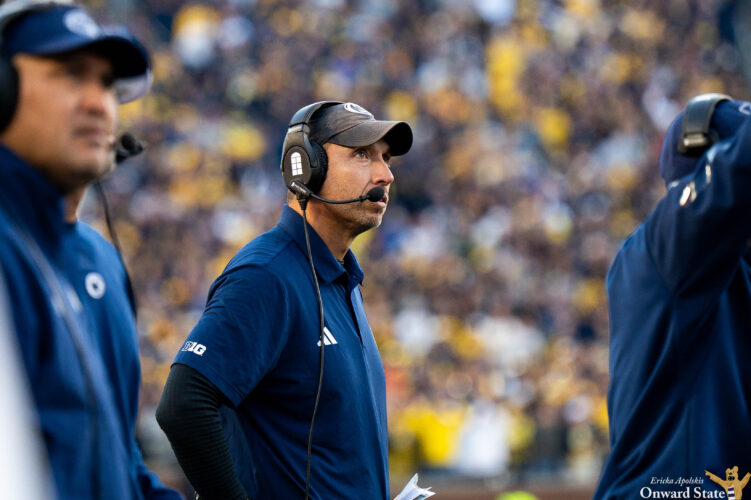
Penn State football is playing winning football again.
But despite the team’s recent successes, one weakness still looms quite large.
The third quarter has been a problem for the Nittany Lions all season. Since the start of Big Ten play, opponents have outscored Penn State 56-16 in that frame, a perplexing stat that has even the coaching staff somewhat at a loss.
Penn State’s second-half troubles first emerged in its Week 4 loss to Wisconsin, a game in which the Badgers crawled back from down 17 points to upset the Nittany Lions in Happy Valley.
That said, Penn State still held a slight edge stat-wise in the third quarter, accumulating more rushing yards, passing yards, and first downs than the Badgers, with both teams scoring three points.
Simply looking at the stats doesn’t tell the full story.
The Nittany Lions had put up 14 points in the second quarter, scoring on back-to-back drives. The offense wasn’t rolling by any means, with one of those touchdowns coming on a Josiah Zayas pick-six, but Penn State found a way to widen its margin.
In its second-to-last drive of the half, a disappointing sequence that featured two rushes for minimal yardage and a sack forced the Nittany Lions to punt.
That’s when Matt Campbell got complacent.
He let the clock run out with possession and time remaining in the first half, hoping to stall the negative juju heading into the locker room.
“When it started negative, I just felt like, man, the biggest thing for us is let’s get this thing into halftime,” Campbell said after the game. “Let’s make the corrections, knowing that we had a really significant lead at that point.”
Penn State scored just a field goal from that point on, giving up the lead and the game.
The following week, the Nittany Lions went scoreless in the third quarter against Northwestern, and once again, the second quarter was their most successful scoring-wise.
It was a similar tale. Penn State capitalized on an offensive miscue from the opponent, this time a fumble.
Then, at the end of the first half, a Ryan Barker missed field goal squandered any chance at momentum heading into the break.
The only difference was the fact that Northwestern, unlike Wisconsin, was pouring it on the Penn State defense at the time. But for the sake of this analysis, it’s somewhat irrelevant.
What I’m really trying to get at is that, for the second week in a row, the team lacked impetus at a juncture of the game when it’s typically needed most.
The Nittany Lions certainly played better against their next opponent, USC, and this time carried momentum from a pre-halftime field goal into two consecutive scoring drives to start the second half.
Still, just three points in the third quarter wasn’t enough, as the Trojans put up seven, then both teams mirrored the box score in the final 15 minutes en route to a USC victory.
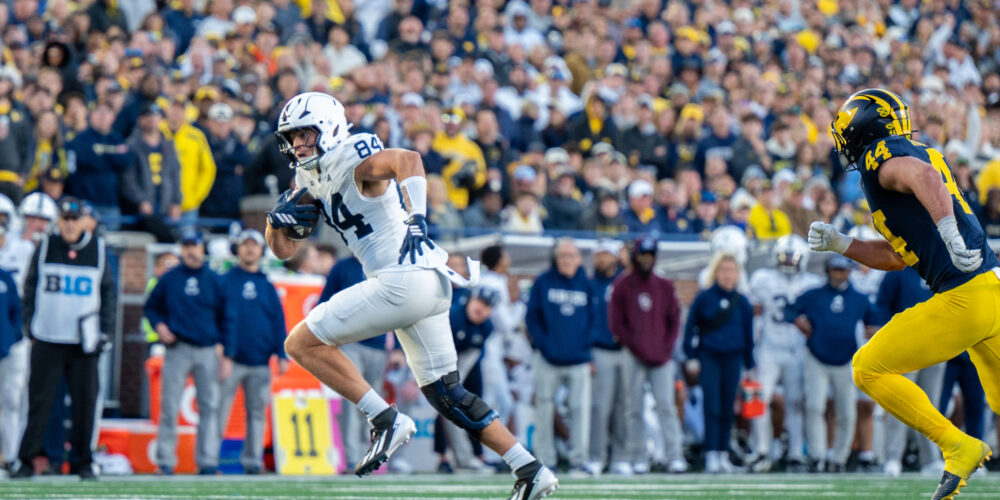
At Michigan, Penn State punted three times in the second quarter and threw two interceptions on two third-quarter drives.
Even when the Nittany Lions began winning again, their third-quarter struggles persisted.
Most notably, Penn State took a 28-point lead into halftime at Washington and failed to score for the rest of the game, nearly blowing what should have been an insurmountable cushion.
So, why exactly does this continue to happen?
Is Campbell really that bad a hype man? Are his halftime speeches so monotonous that the team looks like “The Walking Dead” coming out of the locker room?
Based on the clips from the “Penn State Football Story” series on YouTube, I’m going to rule this one out.
Campbell seems to have his guys ready to run through a wall at a moment’s notice, and his athletes throughout his career have praised his motivational talent.
Questioning play-calling is the next logical step, and there is a lot to be said for that.
Penn State seems to take its foot off the gas when it has a lead, ditching what works and playing less aggressively.
Let’s use the Washington game as an example.
The Nittany Lions had established dominance on the ground in Seattle, yet coming out of halftime, they threw the ball on 10 of their first 12 plays from scrimmage, preventing the team from getting into any sort of rhythm.
On the defensive side of the ball, Penn State faces similar lapses, but this likely taps more into the realm of mental weakness that the coaches have talked about.
“We have to not get bored doing the same thing over and over again,” defensive coordinator D’Anton Lynn said on Tuesday following the game against the Huskies. “As the game goes on, we start getting into the 40s, 50s, and 60s as far as snaps, like we can’t lose that focus when we get tired.”
Campbell has indicated that he’s seen a lack of poise among some of the younger players on the sidelines. When the team must overcome in-game adversity, certain individuals struggle to regroup.
Yet with so much veteran leadership on the team, it seems strange that this should be an issue we’re talking about 10 games into the season.
Campbell said recently that he’s preached the importance of attacking the third quarter throughout his career at Iowa State, and recognized the importance of winning that frame to emerge victorious in tight games.
Let’s look at his Cyclone tenure to see whether he executed that mission.
From 2016 to 2025, Campbell’s teams won the third-quarter battle in all but two seasons.
The first was in 2016, when Iowa State went 3-9. Opponents outscored the cardinal and gold 121-67, a 54-point margin.
The other time came in 2022, when the Cyclones finished 4-8. The competition outscored them 45-34, an 11-point differential.
Those two seasons marked the lowest conference finishes during Campbell’s time in Ames, Iowa, ending the year second-to-last and last, respectively.
That stat doesn’t correlate to a reverse fate on the flip side, however, as a 2017 56-point third-quarter margin in favor of Iowa State, the widest positive differential of Campbell’s career, did not match up with the team’s winningest season.
Returning to the head coach’s point on one-score games, the Cyclones played in 62 contests decided by eight points or less while Campbell was in charge.
In these games, when Iowa State won the third quarter, it went on to win 43.8% of matchups. When the team was outscored in the third quarter, it won 45.8% of its games.
Football is not a perfect science. It’s confusing, and the numbers don’t always add up.
After a holistic look at the situation, Campbell doesn’t seem to be the issue. He’s found success in third quarters in the past, and in fact, it’s been a defining part of his coaching career.
Sure, you can point to the fact that he was dominated in the third quarter during his first year with the Cyclones and liken that to his first year at Penn State.
But the reality is, Iowa State went 3-9 that year, and this Nittany Lion team is infinitely more talented. Analyzing the relationship between the two would be like comparing apples to oranges.
Some are second-half teams, defined by slow starts and dominant finishes. Look no further than the 2016 Penn State squad. And, similarly, some teams are first-half teams.
Teams have identities, and Penn State spent a good chunk of the season trying to figure it out.
With only two weeks left in the Nittany Lions’ 2026 season, it’s time to accept that playing its best football before halftime is one of this group’s defining traits.
Your ad blocker is on.
Please choose an option below.
Purchase a Subscription!
About the Author
Previewing The Enemy: Rutgers Scarlet Knights
It’s been year plagued by injuries for New Jersey’s Big Ten team.
Penn State Football Tight End Gabe Burkle Excited For Future As Sole Nittany Lion Campaign Nears End
Burkle’s torn ACL in late November 2025 delayed his implementation in Happy Valley.
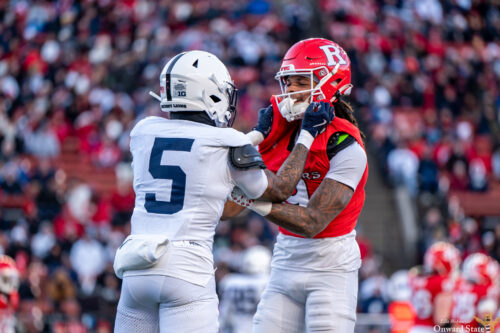
Previewing The Enemy: Rutgers Scarlet Knights
It’s been year plagued by injuries for New Jersey’s Big Ten team.