
The Campus Explorer- Breazeale Nuclear Reactor
The Campus Explorer feature is dedicated to exploring Penn State’s astrologically massive campus. The series will showcase a specific building or area of the campus that usually doesn’t get as much love as Penn State icons like Beaver Stadium and Old Main.
Until October of 2007, the Breazeale Nuclear Reactor was one of Penn State’s most alluring, yet unheard of jewels. At that time, reports surfaced that there was a leak in the pool that houses the reactor. Penn State leadership gave the Reactor’s staff a blank check to fix the issues in the pool. Even though some water did leak out of the pool, it was minimally radioactive so there was never any danger to the public or to surrounding watersheds. In fact, the water in the pool surrounding the reactor is so clean, it meets Federal standards for drinking water. (They told me I couldn’t take a sip though.)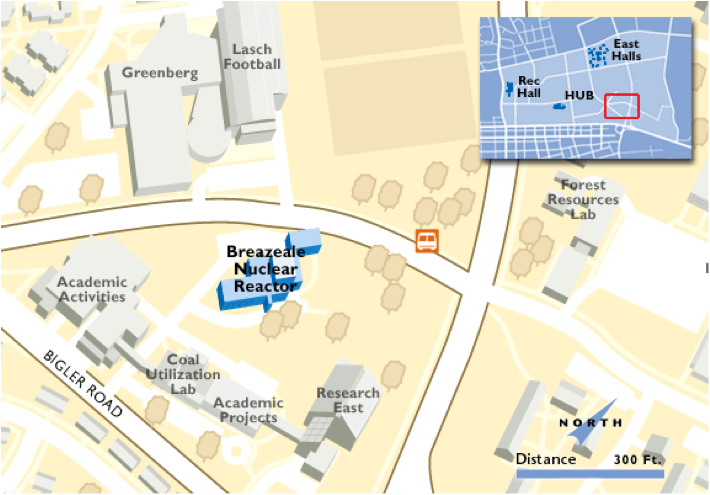
The Breazeale Nuclear Reactor is the longest operating licensed research reactor in the U.S. The reactor, designated R-2, is the result of the “Atoms for Peace” program started by President Dwight Eisenhower. At the time, the President of the University was Milton Eisenhower (the brother of the President of the United States). In 1953, the Penn State Board of Trustees authorized money for the reactor’s construction, and the reactor went live in 1955.
Penn State’s Nuclear Reactor does not provide electricity to the Penn State campus. The Breazeale Reactor is used explicitly for education and research. This is also because the output of the reactor is only one thermal Megawatt and licensed to only operate at that level by the Nuclear Regulatory Commission. (The electricity for campus comes from the coal power plant on the west side of campus on the corner of College Ave. and Burrowes Road.)
Click Read More for the exciting and stunning conclusion of this piece.
Undergraduate and gradate students in the nuclear engineering program, along with 20-30 other departments on campus utilize the reactor in their studies. Nuclear engineering majors are required to take two courses that deal exclusively with carrying out experiments with the reactor. A third, non-required course deals with reactor control and operation.
I visited the Reactor a couple of weeks ago with the Security & Risk Analysis Club. Tours can be scheduled by just about anyone associated with the University with relative ease. Click this link to find out more info about scheduling a tour. The staff asks that you provide them with a list of names of people that will be coming on a tour and checks IDs and faces against that list before they allow you into the facility. After ditching any electronics, particularly any device that can communicate or any cameras, the tour begins.
The tours can be set up to educate visitors on a huge list of topics. On our tour, we got a rundown of how nuclear power works and how the Breazeale Reactor is specially designed to carry out all kinds of experiments. We were then led to the Reactor Room, which houses a 16 feet deep pool with the Nuclear Reactor inside of it. Peering over the side of what is essentially an in-group swimming pool we were shown one of the coolest things I have ever seen.
 Resting at the bottom of the pool was a live Nuclear Reactor. Fuel rods and moderator rods could be clearly seen through the water. A dim glow began to arise from the center of the Reactor as the operator of the Reactor gave the warning that something special was about to happen.
The Reactor was “pulsed” which created a temperature increase of hundreds of degrees during the span of a few milliseconds. Visually speaking, this meant that the dull blue glow of the Reactor rapidly flashed a brilliant, bright blue light for a short instant. When the flash finally faded back into darkness, I quickly closed my mouth (as my jaw had dropped upon seeing the flash).
After viewing the control room to see all of the monitoring equipment, we had a short Q & A session. We were given postcards with a little description of the facility and escorted to the outer gate of the facility. On a side note, if you stand outside the gate for a few minutes or lurk around the facility, Police will arrive.
I would definitely put a tour of the Breazeale Nuclear Reactor on my top ten things to do while attending Penn State. Nowhere else can you stand 16 feet away from a live nuclear reactor with only 16 feet of water separating you from it. The only disappointing thing is that I don’t glow like I thought I would.
Your ad blocker is on.
Please choose an option below.
Purchase a Subscription!
About the Author


Gavin McKenna To Attend NHL Combine & Complete All Drills
McKenna skipped the IIHF World Championship to prepare for the combine earlier this month.

Grading Penn State Hoops 2026 Transfer Portal Additions
Brant Byers an A+? Thomas Allard a C? Read more to see what our staffers graded Penn State hoops transfers.

Three Pennsylvania News Organizations Sue Penn State Board of Trustees Over Free Speech
Spotlight PA, the Centre Daily Times, and StateCollege.com cited the gag policy in the lawsuit.

Question of the Day: Sweet Mobile Apps
AT&T is sponsoring a pretty cool competition in which entrants can win $10,000 cash in scholarship money for creating a mobile device application. Teams of up to four people can enter a custom-built application for the purpose of e-learning. The rules state that the “innovating e-learning mobile app” should be functional across multiple platforms. Submissions are due by September 15, 2010 and so far there are only ten teams signed up. So my question for you is: