
What The NCAA’s Age-Based Eligibility Ruling Means For Penn State Athletics
The most revolutionary change to college athletics in decades is here, folks.
On Tuesday, the Division I Cabinet voted unanimously to approve a directive that overhauls the entire college-eligibility system. The old system has been ripped down in favor of an age-based, five-in-five plan that will officially go into place at the conclusion of the two-day meeting on Wednesday.
From an athlete’s 19th birthday or their full-time college enrollment, whichever comes first, they have five years to play. There are no more redshirts, no more medical exemptions, and no more international prospects getting full eligibility. You get five years, and no matter what, you only get those five years.
While NIL and the transfer portal have certainly changed the way college athletics have functioned over the last five years, nothing has been more entrenched in the NCAA than the eligibility window. Between the COVID-19 pandemic granting extra eligibility, medical redshirts, and various other loopholes, there’s been a considerable push to streamline everything, and that finally came about on Tuesday.
This changes everything. Eligibility has been straightforward for most athletes since 1972, when the NCAA effectively eliminated the freshman and “varsity” divide, allowing freshmen to play on the main rosters in both basketball and football, joining all other sports, which made the change in 1968. This change was made, in part, due to the Southern Airways Flight 932 disaster in 1970, which took the lives of dozens of Marshall football players, prompting an NCAA exemption to fill out the roster.
As straightforward as they promise this system will be, though, there are still exemptions and quirks. The big question: What does this mean for Penn State athletics in particular? That’s what we’re going to answer for you.
Graduating Seniors Who Exhausted Eligibility
Athletes who were playing in their fifth or sixth seasons will not get any extra eligibility for obvious reasons, but they’re not the ones who are getting the short stick.
If you played the last four seasons without redshirting and are graduating after playing four-in-four, tough luck. You were too young to take advantage of the additional COVID-19 year, but too old to take advantage of this system. As such, you get a very weird reality of one or two classes only getting four years of eligibility, while everyone else gets five.
This will almost certainly be appealed in court, so there exists an outside chance that some players will be able to reclaim eligibility, but teams are operating as if this will not happen as the 2026-27 athletic calendar approaches.
The reason for this is to avoid further complicating the offseason calendar for essentially every sport. Especially in big-money sports like basketball and football, it prevents players who went through the draft process from returning.
Even outside football and basketball, this affects athletes like Levi Haines, who exhausted his collegiate eligibility before his 22nd birthday, while other wrestlers exploited loopholes to wrestle as old as 26 this past season.
Penn State baseball’s Michael Anderson, who just finished the best season in program history, will also not be able to return for a fifth season, which he likely would’ve considered if he were underdrafted in this July’s MLB Draft.
Olympic gold medalist Tessa Janecke will also not be able to return for a fifth season for the women’s hockey team, but she’ll be more than happy to start her PWHL career after being picked No. 3 overall in last week’s draft by Las Vegas.
Other notable affected athletes include Alex Ross (men’s lacrosse), Maggie Driver (women’s lacrosse), and Gillian Grimes (women’s volleyball).
Players Who’ve Already Redshirted
Between the graduating seniors and the younger athletes are the players who have already used a redshirt. Unfortunately, they don’t get an extra year of eligibility and had to spend a year on the bench without competition to preserve eligibility they would’ve received anyway.
These players are not quite as screwed over as the ones who are out of eligibility, but it’ll likely sting for them that they were held back for a year to preserve a redshirt that fizzles out during their collegiate careers.
Andrew Rappleyea emerged as Penn State football’s starting tight end late in the 2025 season, and he seems to be most impacted here. He redshirted in 2023 as a highly touted four-star recruit and missed much of 2024 with injury, so he essentially gets shaved down to just three years without being able to apply for a medical redshirt.
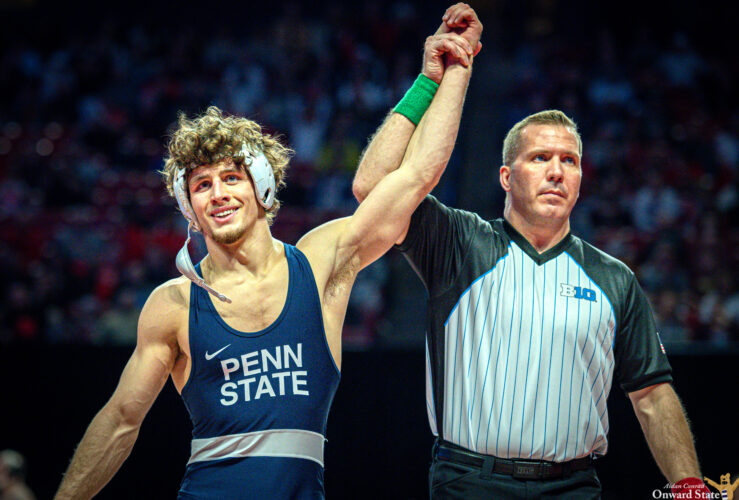
Another player impacted is Penn State wrestling’s Mitchell Mesenbrink. The 2026 Hodge Trophy winner has been unbelievably dominant in his collegiate career, losing just one match in three seasons with two national championships and three Big Ten titles. While an extra year of eligibility would’ve given him a chance to join the exclusive four-time champion club, he won’t get it due to redshirting at Cal Baptist in 2022-23.
This rule change has seemed inevitable for a while now, so certain coaches have definitely been considering it when evaluating whether it’s worth redshirting players and fully ruling them out of action, even when they could help the team on the margins. This is especially true in baseball, something head coach Mike Gambino has talked about:
“It’s a tricky one, because you’ve thought about that five-in-five taking off,” he said when asked about burning redshirts to fill depth due to injuries. “You’re always trying to find a balance between winning and building the program and taking care of kids along the way. I would feel terrible if we bank on that rule passing now and it doesn’t.”
“It’s a weird time in college athletics, so you try to do the best you can with the information we have at the time.”
Other notable players in this window include Tyler Kasak (wrestling), Shayne Van Ness (wrestling), Bryce Molinaro (baseball), Jonathan Evans (men’s soccer), Reggie Grodin (men’s basketball), and Caroline Jurevicius (women’s volleyball).
Players Who Have Not Redshirted
Student-athletes who have not redshirted and have remaining eligibility are the biggest beneficiaries of this rule change, as they can fully use all five years of eligibility, unlike those in the categories above.
That is, of course, assuming these players entered college normally and did not go directly from high school into a separate professional league, such as major junior hockey or European basketball. These players may be impacted by the age-based eligibility exception.
While the men’s basketball team will have to face that problem with several of its international players, they’ll avoid it with center Ivan Jurić, who is among those who will receive a fifth year of eligibility after enrolling at Penn State in his age-19 season.
Penn State football will benefit greatly from this, with notable players getting an extra year, including cornerback Zion Tracy, tight end Benjamin Brahmer, defensive rusher Yvan Kemajou, and linebacker Alex Tatsch.
Penn State wrestling has used redshirts in the past to fit as many of its talented wrestlers into the lineup as possible without wasting eligibility on the bench, but in this system, some will be forced to. The good news is that freshman studs PJ Duke and Marcus Blaze would get a fifth year, which would make their third and fourth-place finishes in 2026 less impactful to their future prospects of becoming multi-time national champions.
Other sports, like hockey, would benefit, but only to a degree. In one example, rising sophomore Jackson Smith would be able to play a fifth year, but he seems unlikely to even finish four years before eventually signing an entry-level contract with the Columbus Blue Jackets, let alone five. San Jose Sharks draft pick Reese Laubach could benefit more, as he’s entering his senior year in 2026-27.
Other notable athletes who will get five true years of competition include Hunter Aquino (men’s lacrosse), Kennedy Martin (women’s volleyball), and Grace Outwater (women’s hockey).
Incoming Freshmen
The biggest winners of this rule change are players just beginning their collegiate careers.
While the best of the best will be treated just the same as everyone else who has not redshirted, it’s a massive opportunity for lower-level freshmen to be able to get sporadic playing time and not have coaches keep them on the bench to preserve their eligibility when they might be able to contribute in some way otherwise.
In football, it no longer restricts freshmen to the four-game window, allowing them to get reps throughout the season without the looming threat of being held back.
While Penn State men’s basketball has a transfer-heavy roster for the upcoming season, future freshmen will be able to get valuable reps late in games that are already decided, as opposed to being forced to sit the entire year to maintain future eligibility.
In sports like baseball and softball, freshmen can serve as mop-up pitchers, designated pinch-runners, and defensive replacements, adding value on the margins and extending the team’s overall depth. In wrestling, guys in the positions of Kasak and Masanosuke Ono would be able to wrestle in tournaments and fill in during sporadic dual meets, rather than basically forgoing an entire year of folkstyle.
But of course, for the blue-chip recruits, it’s an extra year of eligibility to go towards building a tremendous college career. Top wrestling recruits like Jayden James would have an opportunity to chase Carter Starocci’s once-unattainable mark of five individual national titles. Matt Campbell would have a much easier time putting star freshmen on the field, giving them opportunities to make an impact right away.
There are no bigger winners than these incoming freshmen, and it will improve the overall developmental system of college athletics by allowing these players to fill in across all sports when needed, rather than sitting out the entire year on the bench to maintain eligibility.
International Recruits
The last hang-up in all of this centers on the premise of age-based eligibility itself.
If you get five years from your college enrollment or your 19th birthday (whichever comes first), you should be done by your age-23 season. Sounds simple enough, right?
Well, when you look around college basketball and college hockey, it’s not that simple. There are dozens of players in both sports currently playing at age 24 or older, and while some are abusing loopholes to maintain eligibility, there’s an abundance of international prospects making the jump to college and enrolling at ages older than 19.
In college hockey, many players opt to play in juniors after graduating high school and taking advantage of the “delayed enrollment” rule to get full eligibility whenever they enroll. Such a system allowed graduating Penn State men’s hockey alternate captain Jarod Crespo to play through his age-24 season.
But in this new system, delayed enrollment is abolished. If a player spends their age-19 season in junior hockey before making the jump, he loses a year of collegiate eligibility. The later they enroll at a new university, the less eligibility they get.
Once this framework was established this spring, pretty much every amateur and junior hockey league came together to petition the NCAA to consider a sports-specific exemption that would start the clock slightly later to allow junior age-outs to keep their eligibility and not lead to a fundamental overhaul of the sport.
This proposal, which also has support from the NHL, USA Hockey, the CHL, and the USHL, was initially not considered by the NCAA, but eventually was baked into the rule, eliminating language that started an athlete’s clock from their high school graduation to allow for major junior players to be able to use an extra year of eligibility.
As of now, it doesn’t seem like it will affect players who are currently outside the age-based eligibility range, like rising senior defensemen Casey Aman and Mac Gadowsky, who both played in junior hockey before enrolling in college. Gadowsky turned 24 in January, while Aman will turn 24 in January 2027, which would mean neither would have had eligibility under the new system, but will likely be grandfathered in due to the proximity to the season.
This also may shift the eligibility timeline for multiple Canadian Hockey League (CHL) imports. Shea Van Olm finished his freshman year at age 22, while Luke Misa turns 21 in November. Are both now on constrained eligibility timelines? What about for incoming recruit Charlie Michaud or the potentially returning Andrew Kuzma, who looked to preserve eligibility by rehabbing a long-term injury in Canada last year? These things will likely be judged on a case-by-case basis, and the specifics will trickle out.
The consequences here go beyond the players themselves and into the fabric of the sport. College hockey has the reputation of being a grittier, more physical, and more experienced path for prospects to segue into NHL careers. With this massive change causing every roster to get several years younger and less experienced, does it just become a slightly more mature version of major juniors?
Hockey is undoubtedly the most affected by this, but the recent push for international players to enter college basketball is another consequence. Notably, Penn State has gone all-in on recruiting these foreign-born prospects to fill out its roster.
The effect this has on college basketball is less overwhelming than that on college hockey, but the rule was likely drafted for college basketball. The NCAA has been battling numerous lawsuits and injunctions in which former NBA draft picks, G-Leaguers, and even players who have suited up in an NBA game are seeking to return to college, and they are trying to use this rule to fundamentally end all of that.
There’s some confusion over what this means for European prospects, some of whom played professionally in leagues like Liga ACB, Bundesliga, and the EuroLeague. Penn State men’s basketball brought in two older international prospects in François Wibaut and Roko Prkačin in the offseason, so there’s a chance they lose some or all eligibility depending on litigation in response to this ruling.
Any Exceptions?
There will be exceptions in certain cases.
According to the NCAA, the three most common types of exemptions that will be provided will be in the case of pregnancy, official religious missions, and active-duty military service.
Of the three, the most likely to affect a Penn State athlete is pregnancy, by virtue of the other two being more directed at religious and military institutions like BYU and Army. That’s not to say that there won’t be cases in which those players find their way to Happy Valley, but they’d be rare.
One active player who can be used as a blueprint for this is Penn State football defensive tackle Dallas Vakalahi, who’s academically a junior despite being five years removed from his college graduation. He served a two-year mission with the Church of Latter-day Saints before enrolling at Utah in 2024 and spending two seasons there before transferring to Penn State in January. That blueprint will be a big source of over-aged players across college athletics now.
Is This Good For College Athletics?
It’s complicated.
There are many athletes who are positively affected by this rule change and many who are negatively affected. There are seniors graduating who will get the short end of the stick, while some may have their eligibility stripped after enrolling under entirely different rules.
Some teams will benefit, some sports will benefit, while other teams and sports will wind up worse off. It’s truly a case-by-case basis, and it depends entirely on the supplemental cases and rulings we get surrounding all this as the 2026-27 athletic calendar slowly approaches.
But there is one thing that’s for sure with this rule change. College athletics are being simplified, and at least for fans, that’s a big step in the right direction after years of instability and uncertainty.
Your ad blocker is on.
Please choose an option below.
Purchase a Subscription!
About the Author
Hundreds Gather Downtown For No Kings: Bank The Vote Demonstration
The event culminated with a march to the State College Municipal Building to encourage early mail-in voting before midterms.
Penn State Football Names Team Captains Against Michigan
Rocco Becht, Anthony Donkoh, Kooper Ebel, and Blaise Sokach-Minnick received the honor.

NWCA All-Star Classic To Be Held At Rec Hall On November 24
For the second time in three years, 20 of college wrestling’s best will be at Rec Hall for the All-Star Classic.