
The Weirdest Opponents In Penn State Football History
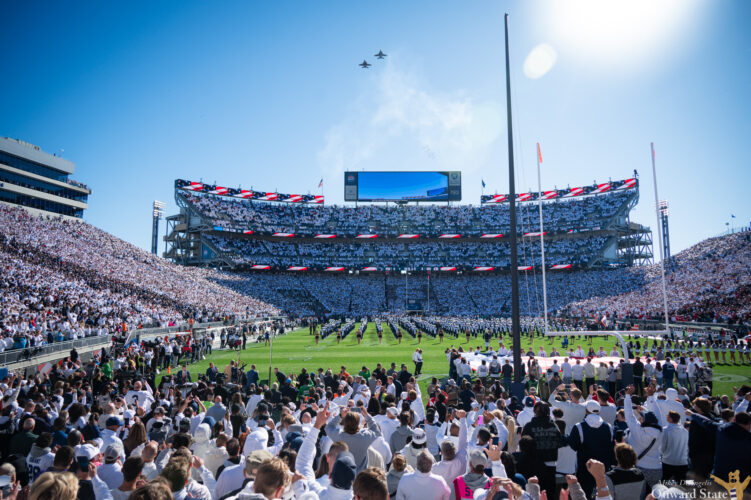
Penn State’s football team is one of the oldest and most historic programs in all of college football, dating back to its grand debut against the University of Lewisburg (now Bucknell) on November 12, 1881, a game that nobody is really sure actually occurred.
Bucknell, notably, denies its existence, and it is not acknowledged in Penn State’s media guide, nor is it ever referenced in the program’s origins. That might be because, by all accounts, it was played as a glorified rugby match that was scored with “goals” instead of touchdowns and field goals. Nonetheless, if the 1869 Princeton-Rutgers game counts, so does this one.
In the sport’s infancy, the Nittany Lions were forced to go head-to-head with a lot of untraditional opponents, spending their first several decades against random athletic associations, low-level colleges, high schools, and even librarians.
The sport wasn’t really standardized for a while, as the division system known today was only established in 1973. Before that, these are some of the weirdest opponents that’ve ever shared the field with the Nittany Lions.
Altoona Athletic Association (1890)
In the early days of college football, many major collegiate institutions would just find any organization or school that could field 11 men and line them up.
In 1890, the first year blue and white became the official colors of the university, Penn State played four games, losing its first two in shutout fashion on the road before heading home in mid-November for this one.
The game against the Altoona Athletic Association was the only one in the 1890 season held in State College, but with football still in its infancy, there was no stadium to play it in. The two sides squared off on Old Main Lawn, where the future Nittany Lions (a name not coined until the early 1900s) blasted Altoona 68-0.
Funny enough, this wasn’t even a one-off matchup. Penn State opened the 1907 season against Altoona, also winning via a shutout at home. A few decades after the all-time series ended with two drubbings by a combined 95 points, a branch campus opened in Altoona in 1939.
Bellefonte Academy (1890)
Here’s a place that straight up doesn’t exist anymore.
Back in 1805, a two-story building in Bellefonte began to be utilized as a college preparatory school, initially housing only a dozen or so students before being expanded in the coming decades.
Although not a university, Bellefonte Academy was one of several high schools to play on a field with Penn State, doing so three times over 19 seasons. The initial meeting, held on the road in Bellefonte, was a 23-0 win for the Nittany Lions. They ran it back in 1906, when Penn State won 12-0 at home, but the final meeting in 1908 went the way of Bellefonte, coming on the road to stun Penn State 6-5.
As for the academy itself, which enjoyed a ton of football success in the early 20th-century high school circuit, it lasted a century before a fire nearly razed it all to the ground in 1904. After it was rebuilt, it had another 30-ish years until it was closed for good during the Great Depression.
The building itself lasted for 200 years. It was converted into apartments before being burnt down in 2004 after two children playing with a lighter went horribly wrong.
Wyoming Seminary (1892)
No, this isn’t a team from Wyoming, but a lot of you probably knew that. Located just outside of Wilkes-Barre, Wyoming Seminary is a college-preparatory boarding school that is most well-known for being a high school wrestling powerhouse. Notable Nittany Lions to come from there include Luke Lilledahl, Joe Sealey, and Beau Bartlett.
The state of football in the late 19th century was the only time in history when you would see a school like Penn State go on the road to play a high school, which is exactly what happened on October 14, 1892. The visitors won in a 40-0 bloodbath, although a very biased local newspaper claimed that Wyoming Seminary fought hard and even outplayed Penn State at times. Imagine saying that Penn State outplayed Michigan in the Big House in 2016.
Pitt Athletic Club (1892)
Here’s another athletic club, but one with a much more interesting story than the one in Altoona. Turns out, Penn State’s first rivalry with the city of Pittsburgh wasn’t, in fact, with Pitt. It was with a semi-pro athletic club.
A year before the first edition of Penn State-Pitt, the future Nittany Lions traveled to the Steel City to face the Pittsburgh Athletic Club (P.A.C), whom they beat 16-0 on November 5, 1892. The matchup was repeated at PAC Park for the next three years, with Penn State taking the first two, while the P.A.C. got the last laugh with an 11-10 win in 1895.
The real kicker with this one is that, just one week after their shutout loss in 1892, the P.A.C. made history. Three-time All-American lineman Pudge Heffelfinger, who had just graduated from Yale, had both the P.A.C. and the Allegheny Athletic Association bidding for his services for the November 12 game against each other, an unprecedented thing at the time.
The P.A.C. offered $250, but Heffelfinger suited up on the other side after being given $500. He went on to score the game-winning touchdown. Heffelfinger is widely considered the first professional football player, as this was 30 years before the NFL was founded.
Oberlin (1894)
Oberlin College fits the bill of the dozens of other current Division III schools that populated the early days of Penn State football schedules, but some of these teams were more notable than others.
On November 24, 1894, just one day after defeating Washington & Jefferson just outside of Pittsburgh, Penn State traveled to Northern Ohio to play Oberlin for the one and only time, winning 9-6. Putting aside how odd it was to play a football game on back-to-back days, the real notoriety from this game was the man coaching the home Yeomen.
In his second and final season at Oberlin, John Heisman’s group went 4-3-1 before he left the game of football temporarily to live on a farm in Texas. One year later, he was hired as Auburn’s new head coach, where he’d truly gain the momentum to be the innovator of the game of football. He also coached at Clemson and Georgia Tech at the start of the 20th century.
Did losing to Penn State cause his journey? Streets are saying.
Bloomsburg Normal (1897)
Let’s get weird.
In 1897, Penn State wasn’t very good at football, but one of the three games they did win was against a bunch of teachers.
Remember, the concept of a student-athlete wasn’t really much of a thing in the late 19th century, so these were almost always just students playing some version of what we’d consider a club sport today.
This game, played on November 20 at Old Beaver Field, saw Penn State defeat the Bloomsburg Literary Institute and State Normal School, 10-0. A normal school, back in the day, was an institution that trained high school graduates to become teachers.
This is basically the equivalent of the current football team playing an intramural all-star team of people from the College of Education.
Homestead Library & Athletic Club (1901)
If you thought a game against teachers was fun, how about a game against librarians? Well, kinda.
This wasn’t as simple as some who’ve found the game and joked about it on social media made it sound. Contrary to their name, these guys were really good. Nine years after the concept of a pro football player came about, Homestead decided to field an entire team of them, full of college All-Americans who had already graduated and were financed by the co-owner of the Pittsburgh Pirates and Carnegie Steel.
The team, whose payroll was $25,000 in total, crushed all 11 opponents they faced, including Penn State, which suffered a 39-0 blowout defeat in Allegheny City on November 2. Seems like the library is a bit deceiving, no?
Dickinson Seminary (1902)
Here’s another program that, like Wyoming Seminary, was a high school at the time of the game, but it’s what’s happened since to Dickinson that makes it notable.
Penn State blew out Dickinson Seminary in consecutive years by a combined 87 points from 1902-03. At the time, the group of players playing in these games were at a place specifically meant to prepare students for Dickinson College, but the seminary soon split into its own thing.
By 1921, it shifted into Pennsylvania’s first junior college after a State College pastor became president at the institution. In 1948, the school fully ditched its association with Dickinson, becoming Lycoming College, a four-year institution that currently plays in Division III.
Steelton YMCA (1902)
Let’s play with a group of football players from the local YMCA. Why not?
After beating Dickinson Seminary to improve to 7-3, Penn State concluded its 1902 season in Steelton, Pennsylvania, against the local YMCA, which punched the Nittany Lions in the mouth. There’s not much about this game, but Steelton stunned the Nittany Lions 6-5 on November 27 to conclude their season on a sour note.
Jersey Shore Athletic Club (1904)
There’s pretty much nothing you can find about this team, but Penn State hosted the Jersey Shore Athletic Club on October 29, 1904, and shut them out 30-0. At first glance, you might wonder why a random athletic club from the Jersey Shore would come to State College and play a game, but there is a town in Lycoming County named Jersey Shore, which surely doesn’t cause much confusion.
Geneva (1904)
This one’s a hoot. Unlike some of these other teams, Geneva’s football team hailed from a real college out in Beaver Falls, Pennsylvania, just west of Pittsburgh. The Nittany Lions faced them a total of seven times from 1904-16, winning by no less than 34 points in every game, all of which took place in State College.
The level of dominance in these matchups was unrivaled. In 1911, Fritz Barrett ran for a 109-yard touchdown on a 110-yard field, setting a record that will never be broken in American football. In 1916, Penn State won 79-0. Some of the most lopsided games in program history happened here, so it makes sense that Geneva currently competes in Division III.
To illustrate the transitive property, it’s important to highlight the first game in the series, won by Penn State 44-0 on November 19. In the exact same year as that game, 1904, Geneva won their lone contest against the Pittsburg Deaf Mutes.
This isn’t a misunderstanding, like the Mississippi College for Women still having men. This was a team of deaf individuals who played a 25-minute game against a team that also shared a field with the Nittany Lions.
Army Ambulance Corps (1917) & Wissahickson Barracks (1918)
During both World Wars, plenty of college-aged men were enlisted to fight overseas, leaving college football rosters depleted and making teams like Army and Navy powerhouses. While schedules were still normal during World War II, Penn State played one game in consecutive seasons against odd opponents during World War I.
To open the 1917 season in late September, Dick Harlow’s Nittany Lions defeated the Army Ambulance Corps in a competitive 10-0 matchup played at a neutral site in Allentown. Considering that Penn State outscored St. Bonaventure and Gettysburg College by a combined 179 points over the next two weeks, that’s impressive.
The following year, as the war wound down in Europe, the Nittany Lions hosted a team from the Wissahickon Barracks, a 6,000-man naval station in Cape May, New Jersey, on November 2, just nine days before the armistice. This wasn’t a good year for Penn State football, so it was a bad omen when the season started with a 6-6 tie to a bunch of naval officers.
Sewanee (1932)
In the early days of college football, travel was pretty limited. Penn State would almost exclusively play teams from Pennsylvania or the surrounding states, with cross-country travel being limited to special occasions (the 1924 Rose Bowl was notably the only time before 1948 that the team traveled out west). This doesn’t quite count as that, but it’s a fun opponent.
The Nittany Lions played host to Sewanee: The University of the South on November 5, 1932, at New Beaver Field. Sewanee, a longtime southern powerhouse, was making a rare trek up north.
It was the only game the visiting Tigers played outside the South, but it was still one of eight road games in a brutal 10-game slate. Fresh off getting whooped by LSU the week prior, Sewanee fell 18-6 to Penn State in a game that the local newspaper thought could’ve been more lopsided.
The most notable part about this game and matchup? Sewanee became one of 13 schools to secede from the pre-existing Southern Conference to form the SEC just 33 days later.
Despite being a founding member of a future powerhouse conference, the Tigers were kicked to the curb after eight winless seasons in conference play, never recovering to the level of the early-20th-century powerhouse it was. They currently play in Division III.
Western Maryland (1935)
The run of interesting opponents unfortunately stops before World War II. In mid-October 1935, Penn State played host to the visiting Western Maryland Green Terror, a team you may never have heard of, but was a powerhouse in pre-WWII college football.
The Green Terror claimed a national championship in 1929, were invited to the inaugural Orange Bowl in 1935 (before declining for some reason), and are believed to have been early innovators of two staples of the modern game.
While the forward pass was officially permitted in college football in 1906, one sportswriter claimed it was Western Maryland in 1908 that truly innovated it. Less controversially, the Green Terror is also credited with inventing the shovel pass, with quarterback Stoney Willis cited as the first to throw it in 1932.
Despite being offensive innovators, the two teams’ matchup in State College in 1935 was quiet, as neither team scored. The ultra-rare 2-0 victory went to the Nittany Lions.
In the years since, Western Maryland has moved down to Division III and renamed itself McDaniel College. To this day, it is the most recent non-Division I school to have taken on the Nittany Lions, even if the division structure itself was created 38 years later.
Your ad blocker is on.
Please choose an option below.
Purchase a Subscription!
About the Author


Penn State BOT Finance Committee Recommends Sale Of Wilkes-Barre Campus For Golf Course
Some academic buildings will be left to Misericordia University.
Penn State Wrestling To Visit Lehigh On December 6
The second non-conference date of the 2026-27 schedule has been revealed.
AT&T To Upgrade Beaver Stadium Cell Service For 2027-28 Season
The upgrade’s goal is to make mobile service more reliable during football games and other events held at Beaver Stadium.
Penn State Wrestling To Visit Lehigh On December 6
The second non-conference date of the 2026-27 schedule has been revealed.