
‘He’s Real’: Penn State Baseball Pitcher Genei Sato Brings Must-Watch Talent From Japan To Happy Valley
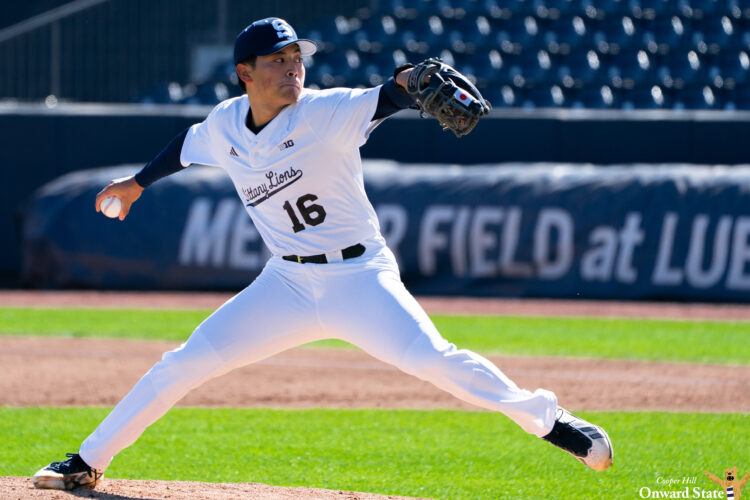
Kuroishi City, Japan, is a large but sparsely populated city of just over 31,000 in Aomori Prefecture at the very top of Japan’s main island of Honshu.
It’s a four-hour drive from the nearest major Japanese city of Sendai, and an eight-hour drive from Tokyo. It gets a lot of rainfall in the summer and a lot of snowfall in the winter. The sun is present, but never truly overbearing.
In many ways, it’s like State College, Pennsylvania.
Folks in the baseball industry have wondered why Penn State baseball star pitcher Genei Sato — a top Japanese prospect and a lock as a first-round pick in the 2026 Nippon Professional Baseball Draft — came overseas to play in a place with little baseball legacy.
Penn State has directly produced just one major leaguer in the last two decades (Justin Hagenman). The program’s most famous players came before integration. The Nittany Lions haven’t made the NCAA Tournament in a quarter century.
Why would one of the world’s best pitching prospects come play here?
Maybe, just maybe, it reminds him of home.
Sato grew up in Kuroishi City and attended Sendai University. Like many Penn State students, he traveled several hours from his hometown to pursue his academic future. The distance from Kuroishi City to Sendai University’s campus is about what folks who live in New Jersey, New York City, or eastern Ohio experience when they go to school in Happy Valley.
While pursuing his studies, Sato became a star for the magic he could conjure with his right arm.
At Sendai University, Sato posted a 2.22 ERA over 170.1 innings, striking out 196 batters while allowing just 62 walks. He quickly became a premier young talent in the baseball-obsessed nation, earning a spot on the 2025 Japanese Collegiate National Team.
There, he became a star. In an all-star series against Team USA, he struck out six across 4.1 one-run innings, helping Japan sweep the five-game series as the closer.
His high-90s fastball consistently fooled some of the best that college baseball had to offer, including future No. 1 overall pick Roch Cholowsky, who struck out against Sato.
“He’s real,” Cholowsky told Baseball America after the game. “[He] was like 97-99, throwing a splitter at like 92. A lot of ride on the fastball. Throws his splitter hard but has depth on it, too.”
That performance skyrocketed his stock in his home country, giving the 5-foot-11 righty near-certainty of a first-round selection in the 2026 NPB Draft. Such status could have come with a big immediate payday, and the potential to earn even more if he wanted to come stateside a few years later.
Except, Sato wanted to come to America now. He made a stunning announcement last December when he decided to follow in the footsteps of Stanford’s Rintaro Sasaki (who’s since been drafted by the Miami Marlins) and transfer to a college baseball team to pursue the MLB draft instead.
Rumors swirled about where he would go before he eventually chose Penn State. As part of the plan, he came to America and enrolled, though he couldn’t compete until 2027.
“When Genei’s camp reached out to explore a move to college baseball, our staff used their connections to gather reports and video and it became clear to us that this is a premium arm,” Penn State manager Mike Gambino said when he signed.
“He’s in the conversation among the best arms in Japan and was considered a top draft prospect in the Nippon League and has the potential to be a top-round pick here.”
Penn State’s prior experience acquiring international talent, particularly with Gavin McKenna in hockey and Masanosuke Ono in wrestling, helped the pitch.
“We were uniquely prepared for this situation as a department when it came up,” Gambino said. “He was looking for player development and people that he trusts. He fell in love with Penn State, our university, and what the program was about. He was excited about getting a Penn State degree as part of his journey.”
That coup gave the program the national recognition it had lacked for decades, one that would fade as the program failed to take that momentum into a difficult 2026 season, but the Nittany Lions once again have a reason to be excited in 2027.
Sato was finally in the blue and white.
The first step was fall ball, a concept that is foreign in Sato’s home country. Here, the coaching staff prepared him for his weekly role. He is the ace; he will go every Friday night (health permitting), and he is expected to be the key to the Nittany Lions’ success this year.
Sato didn’t throw more than 60 pitches in any of his four outings this fall, but he dominated all of them. When it was all said and done, against three mid-major Division I teams and one junior college team, he tossed 11 shutout innings with 22 strikeouts.
SR RHP Genei Sato (@PennStateBASE); 5-11 177LBS
— Prep Baseball Pennsylvania (@PrepBaseballPA) October 21, 2026
FB: 95-97
SL: 80-82
SPL: 88-90
Potential Day 1 pick & looked the part. Smooth, easy operator generating effortless velo
Utilized entire arsenal inducing IZ & OZ whiffs. SPL displayed late tumble & FB holds plane w/ ride &… pic.twitter.com/cgIozCYdsF


His stuff was electric, consistently hitting 96-97 on his four-seam fastball while fooling hitters with a high-80s “supreme” that looks to be a mix between a splitter and a changeup. As incredible as he’s looked so far, it’s still a work in progress.
How can someone who’s ranked as the No. 47 draft-eligible prospect for 2027, according to Baseball America, be a work in progress? Well, to answer that, you just need to look at the information gap between amateur Japanese and American baseball.
“I think he showed up with a really good arm and, honestly, one pitch,” Gambino said after last Friday’s fall ball action. “He had never been on any ball flight data. He’d never been on TrackMan like that. He didn’t have a real clue about pitch design, didn’t have much routine.”
While Japan is rapidly becoming a premier factory of baseball talent, the gap in sporting technology with the United States still exists. In his few months in the country, Sato has already made big strides.
“Where he came from and the progress he’s made with [pitching coach Will Jauss] and [director of pitching technology Ford Ladd],” Gambino added. “His routine has gotten stronger; he’s holding his velo longer than he has.”
His talent isn’t the only thing that’s impressed the Nittany Lions’ manager; his journey to get here has, too.
“I think we all have to think about how impressive it is for a young man to say ‘I’m going to be the first overall pick in the [NPB draft]’, but to say ‘Now, I want to come over here,’” he said. “I think the two things that are really important to him that we talk about all the time are: one, he wants to get his Penn State degree, and he wants to be a first-round pick [in the MLB draft].
“He wants to pitch in the big leagues, and that’s just the way he thinks he’s going to do it.”
Sato’s next appearance on a college baseball mound will be the first one that counts. It’ll likely come in the Bahamas against a premier SEC talent, Auburn, in mid-February, over 100 days from now.
Gambino’s teams have embraced early-season challenges in the past, but haven’t had the talent to stack up. Sato might be that ultimate equalizer.
He’ll only spend one season in the blue and white, no matter how this season goes for him or the team. Eligibility-wise, the 21-year-old is a senior, and with his tantalizing stuff, he’ll be drafted high next July either way. If that somehow fails, he has a fallback in Japan after being selected in the ninth round of the NPB Draft out of courtesy.
Sato represents something bigger than himself in multiple facets.
He’s trying to pave the way for Japanese youngsters behind him to see that a different path is possible than staying in the NPB and waiting for the posting system.
He’s trying to be the first person from his hometown of Kuroishi City to play in the major leagues.
Penn State also hopes he sparks a new golden age for a long-dormant baseball program.
What the baseball world has seen as an odd pairing might be more perfect than anyone thought. A player whose hometown mirrors his college town in so many different ways, from the climate to the distance from major cities to the uncharted ground in baseball.
Maybe this spring, this union can turn into something that can truly elevate both sides into the stratosphere.
“I think it’s going to be something that people are going to want to come out and see in the spring,” Gambino said. “Because I think it’s going to be pretty fun.”
Your ad blocker is on.
Please choose an option below.
Purchase a Subscription!
About the Author
How Centre County Voted In The 2026 Midterm Elections
Centre County saw a 55.32% voter turnout rate in the general election.
Penn State Football Defensive Tackle Keanu Williams Excited For West Coast Trip
“That was one game my mom was like, ‘Yeah, I’m coming. Make sure you got some tickets for me.'”

Penn State Blue Sapphire Delaney Higgins Hopes To Leave Lasting Legacy In Community
“I definitely want to leave a legacy of inspiring young kids to just really be themselves.”
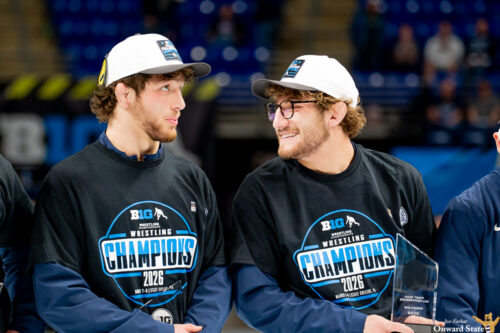
Examining Penn State Wrestling’s Biggest Lineup Battles In 2026-27
Just one week before the defending champions take the mat, it’s still unclear who’ll be the ones wearing the singlets.