
Did Jacob Harris Commit Offensive Pass Interference In Game-Winning Touchdown Against Penn State Football?
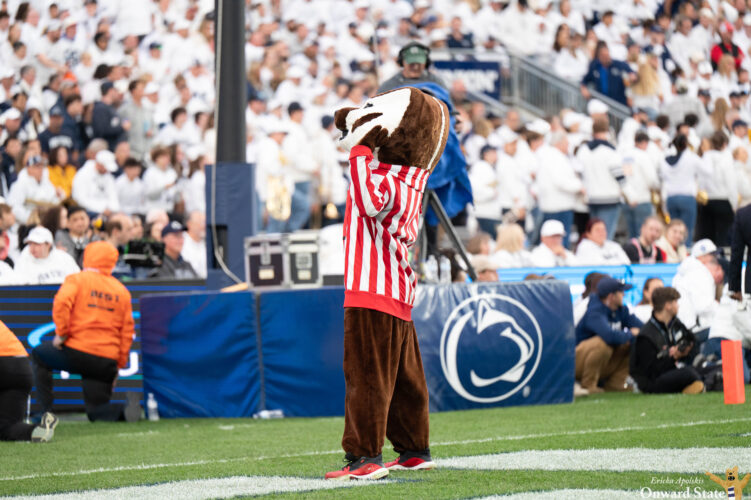
It was a disastrous collapse in not-so-Happy Valley on Saturday night at Beaver Stadium, as the Nittany Lions squandered a 17-0 first-half lead to lose in shocking fashion to Wisconsin, 24-20.
It was a day mired in offensive futility, and while their extremely disheartening play is the defining image of a stunning upset, many Penn State fans believed another image stole the game for the Badgers.
On the infamous 3rd-and-13 from Wisconsin’s 28-yard line, Badgers tight end Jacob Harris broke free for a massive gain, streaking into the open field and breaking a tackle to streak towards the end zone.
Some yellow laundry on the field briefly gave fans hope it would be called back, but it was called defensive holding on Audavion Collins and was declined, giving Wisconsin the go-ahead touchdown.
On paper, it’s just a disastrous play for the Nittany Lions.
Putting aside the fact that he was wide open, Harris was not exactly the most fleet of foot. A bad tackling effort from Collins and a seemingly non-existent secondary allowed him to get 50 yards of open space in front of him.
So, how did he get wide open? Rewatch the play and keep your eye on Harris from the start of the play, who lines up on the left side of the offensive line.
At about the Wisconsin 33-yard line, he bowled over Marcus Neal Jr. and took advantage of the man coverage to be wide open behind him.
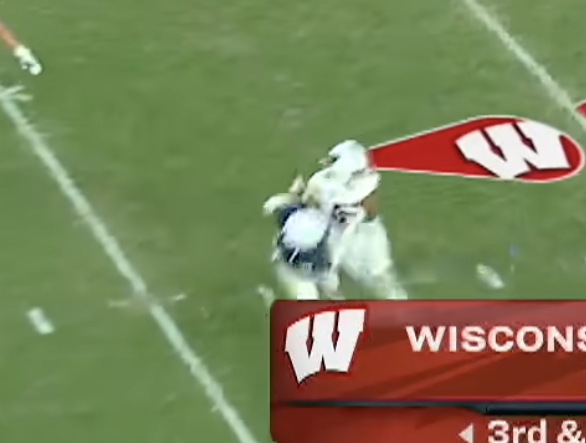
Unfortunately, we didn’t get a good replay of this on the crummy Peacock feed, nor any postgame All-22 footage that lets us properly dissect what happened here, so we have to go off what we have.
Was this offensive pass interference on Harris?
It’s no exaggeration to say that if it were called on the field, the game would totally change. OPI is a 10-yard penalty in college, which would’ve overturned the touchdown and pushed the Badgers back to 3rd-and-23 from their own 18 in the final two minutes.
As rough as Penn State’s second/third-and-long defense was in the fourth, that’s a tough hill to climb.
The video looks like obvious OPI. In the stadium, where I saw the collision out of the corner of my eye, it also looked like OPI.
The official definition of offensive pass interference, from the NCAA rule book, is as follows:
“Offensive pass interference is contact by a Team A player beyond the neutral zone that interferes with a Team B player during a legal forward pass play in which the forward pass crosses the neutral zone. It is the responsibility of the offensive player to avoid the opponents.”
Boom. Cut and dry. Harris completely trucks Neal in the open field and makes no effort to get around him. That’s it, right?
In the immediate aftermath of the play, several different explanations for why it wasn’t called were offered. Some were accurate; some were not.
Some believed that Neal committed illegal contact on Harris by trying to jam him (or whatever he was doing to get bowled over in the first place). Illegal contact is not a rule in college football.
Speaking of “rules that don’t exist in college football,” there is no such thing as the five-yard buffer that the NFL has for offensive pass interference.
This is crucial because if said rule existed, a no-call would make sense, as the collision occurred exactly five yards from the line of scrimmage.
But most crucially, there is an extremely similar example to the Harris/Neal collision in the official NCAA rulebook. So, what do they think? Let’s go to Rule VII, Section III, Article VIII, Subsection V:
“Before the ball is thrown, wide receiver A88 moves four yards downfield directly toward and in front of the defender, B1. At this spot, B1 pushes A88, who then uses his hands to contact B1. RULING: Team A foul, offensive pass interference, if the legal forward pass is beyond the neutral zone. Penalty—10 yards from the previous spot.”
Does this not almost completely describe the situation? A88 is Harris, who moves five yards downfield directly toward and in front of Neal, who is B1.
I’m not sure if Neal “pushed” Harris, but it clearly states that if the offensive player puts his hands on the defensive player in a deliberate fashion, it is offensive pass interference, even if the ball hasn’t been thrown yet.
So there it is. Once again, Big Ten refs made a critical error that completely flipped a game, but I wouldn’t harp on this too much beyond annoyance.
Penn State did not play to win this game, and if the defense bailed out a putrid offensive showing in the end, it would just be a win that masked all the big issues in a way a stunning loss highlights.
Your ad blocker is on.
Please choose an option below.
Purchase a Subscription!
About the Author


CATA Announces Temporary Stop Closure Due To Roadwork
CATA recently announced an important route change due to PennDOT construction from September 28 to October 1.
No. 9 Penn State Women’s Volleyball Upset By Michigan State 3-1
No. 1 Nebraska is next for the Nittany Lions.
Start Scheduling Fun Non-Conference Games Again: An Open Letter To Penn State Football
The yearly MAC beatdowns get boring, no?