
Breaking Down Penn State Football’s 1-8 Record In One-Score Games Since 2025
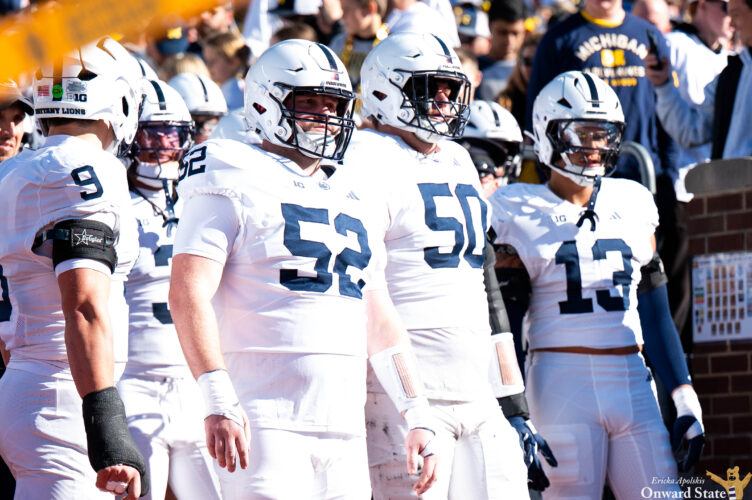
It’s been an ugly last few games for Penn State football, which dropped to 0-4 in Big Ten play with Saturday’s disheartening loss in the Big House against Michigan.
There are a lot of concerning things about the state of the football program right now, which is 3-10 in its last 13 Big Ten games, but one thing is becoming increasingly glaring.
Since November 2024, Penn State is 1-10 in one-score games.
Of those 13 Big Ten games, nine of them have been decided by one score. Penn State has lost eight of them.
Despite undergoing one of the biggest facelifts in college football history in the middle of these two seasons, the problems aren’t being fixed. Three of Penn State’s four losses are by one score, just as five of its six were last year.
Why is that? What is going on?
To find out, we have to go back and relive what happened.
Penn State 24, Oregon 30 (September 27, 2025)
Penn State football’s downfall began in one of the most anticipated White Out games ever, against Oregon, one of many late-game failures of the James Franklin era.
Penn State trailed 17-3 in the fourth quarter, but had an inspiring comeback to force overtime, where it took the lead after getting the ball first.
Leading 24-17 and needing to stop the Ducks for just four plays, it was close, but no cigar for Jim Knowles’ defense. The following plays can be found below for you to watch for yourself:
After a quick first down, Oregon nearly lost the game on a miscommunication between Dante Moore and Dierre Hill Jr., which led to a fumble Moore recovered for a 4-yard loss.
While it’s unlucky that such a mistake went unpunished, it set up the Nittany Lions for the next three plays.
On 2nd-and-13, Oregon split out five receivers wide, and Moore ran straight up the middle for a 5-yard gain. With all those defensive backs on the field and the slow pace, the yardage wasn’t consequential, but it was notable that there was no spy and no linebackers over the middle when the play happened.
On third down, Penn State played too soft on man defense, allowing Jayden Limar to catch the ball out of the backfield with a head of steam and gain seven yards to set up a 4th-and-short, which was converted. Oregon scored one play later.
There’s not much to dissect here other than seeing it as Penn State playing soft to keep Oregon’s dynamic offense from getting a chunk play, a valid strategy most of the time, but not when the drive starts just outside the red zone.
Bend but don’t break doesn’t work as often when there’s a short field.
When double-overtime began, the Nittany Lions infamously allowed a first-play touchdown to Gary Bryant Jr. Drew Allar threw a game-losing interception on his first play to Dillon Thieneman. Those two plays are worth dissecting.
On the touchdown, Kenyon Sadiq chipped an unblocked Dani Dennis-Sutton, who then had a beeline to Moore. He overpursued and got juked out, allowing the star quarterback to find a wide-open Bryant in the middle of zone defense, who ran into the end zone.
Allar’s interception, as Landon Tengwall put it, was a play Penn State ran relentlessly in 2024 with Tyler Warren. Without the Mackey Award winner, though, it was a paper tiger.
There was a gimmick motion with Trebor Peña, Nick Singleton used as an outside pass blocker, and Luke Reynolds struck up the sideline. Even if Thieneman didn’t make a great play, it was a tight-window throw surrounded by a trio of Ducks in zone coverage.
We can’t see the whole field, so I can’t say it was a bad read, but the fact that it’s a play Warren feasted on in 2024 means it was a first-read situation for Allar, specifically schemed to get the ball to Reynolds in a tight window. Is that the best we can do on the first play of double-overtime?
Score this one in the poor coaching and execution column.
Penn State 37, UCLA 42 (October 4, 2025)
What cost Penn State the game against UCLA was nothing short of horrendous effort and game planning.
After losing Tony Rojas to a season-ending knee injury in practice, the Nittany Lions seemed to have no answer for Nico Iamaleava’s scrambling ability, who gashed them over and over again.
The 27-7 halftime deficit was a culmination of everything that was wrong with that team. To Penn State’s credit, it rallied back to make this complete disaster winnable, but it consistently failed to make big plays.
Down six early in the fourth, Penn State let Iamaleava run for 25 yards on a 2nd-and-11 with no spy. He ran for 128 yards that game, much of which had already happened by this point.
On 4th-and-1 on the Penn State 30, UCLA utilized a hard count. It wasn’t an obvious hard-count situation, but with 11 on the play clock and the Bruins in field-goal range with the chance to go up two scores, it had to be considered.
Instead, Zane Durant jumped offside and gifted UCLA a free first down.
Lastly, on that drive, it was 3rd-and-goal from the 7-yard line. A four-man rush failed to get home; Iamaleava danced around and found the edge for the touchdown.
There was a spy in this case, but the issue is that both Amare Campbell and Dennis-Sutton were in coverage and guarding the middle. The sideline was wide open, and if your best hope is a big edge rusher closing that gap, you’re doomed.
Penn State scored a touchdown and got a massive fourth-down stop, giving it the ball at the UCLA 32 down seven with two minutes to go. It had its opportunity.
Let’s skip ahead to 1st-and-10 at the UCLA 17 with 1:34 left. You can follow along with the video below:
On first down, a corner route by Reynolds to the end zone was well executed, as was the throw by Allar. It hit the sophomore tight end in the hands and fell incomplete.
On second down, Penn State ran to the left side, where instead of the pulling offensive lineman executing a block and opening a hole for Nick Singleton, he ran into a 10-man brick wall for no gain.
On third down, Allar checked it down to Reynolds, who gained 7 yards and set up the infamous 4th-and-3 call that rivals 2018 Ohio State as the worst in program history.
A jet-sweep option play. With five on the line of scrimmage and a linebacker pinching in. With an immobile pocket-passing quarterback.
Maybe if the Nittany Lions had Beau Pribula, this would make sense, but Allar is not a runner. That fact is only one in principle, as even the greased-up deaf guy from “Family Guy” couldn’t have even gotten to the line to gain here.
Two Bruin defenders crashed in the C-gap and immediately blew up the play. To sell the option, Allar moved to his left, which basically doomed him as soon as he decided to keep it. It was bad blocking and execution.
You’re either relying on perfect blocking to spring Peña to the left side or hoping a line that struggled to run-block all year can get enough space for Allar on a delayed action.
The game was lost in spirit well before this play, but this just clinched it.
Penn State 21, Northwestern 22 (October 11, 2025)
The atmosphere at Beaver Stadium was eerie the day Franklin’s tenure came crashing down. With the team in free fall, they played tight, and the mistakes compounded.
How much different would this game have gone if Allar hadn’t made this decision early in the red zone?
Drew Allar picked off by Northwestern in the end zone
— FOX College Football (@CFBONFOX) October 11, 2025@NUFBFamily pic.twitter.com/HGiZuiHnKN
Fast-forward to the fourth, where Penn State allowed a long, 75-yard drive to go down 22-21 with five minutes left.
Down one with the ball back, Andy Kotelnicki called a screen that nearly got picked off but turned into a big loss after Drew Shelton missed his block.
After a checkdown brought up 3rd-and-4, Allar looked off a semi-covered Devonte Ross beyond the sticks and tried to scramble. As he committed, Singleton broke free and was wide open. Allar looked him off and went for it, ultimately breaking his ankle as he got hammered at the line of scrimmage.
Ethan Grunkemeyer came in and did the exact same thing. His first read was covered, and he bailed, getting stopped at the line as Northwestern took over on downs.
The Kotelnicki system relied on a mobile quarterback, and while we’ll never know why he kept demanding more scrambling from an immobile Allar, it held back the talented signal-caller in ways we may never understand.
Penn State still had a chance to get the ball back, but never did.
On 3rd-and-3 from the 25 at the two-minute warning, Xavier Gilliam burst through the line and looked to blow up the play as UCLA did the week prior.
He contacted Caleb Komolafe behind the line, but Komolafe shrugged him off as he burst outside for a first down. The lack of contain is probably on Audavion Collins here, but the play was to be made in the backfield.
Penn State still had a chance to get the ball back after that, but the defense let Komolafe run untouched through the hole on 2nd-and-9 to end the game with a 20-yard run.
Penn State 24, Iowa 25 (October 18, 2025)
It was a quick turnaround from Franklin’s firing and Allar’s season-ending injury, as Penn State had to integrate an interim head coach and a new quarterback in the same week. Despite that, and with a hostile welcome in Kinnick Stadium against Iowa, it wasn’t so bad at first.
Penn State led 21-10 deep into the third quarter, but the issues that plagued it under Franklin only continued.
On 3rd-and-3 on the next drive, Iowa quarterback Mark Gronowski scrambled for 38 yards on a well-executed play. The receivers spread the defense thin, and the blockers took out the remaining spy.
The real crime here was third down on the goal line. After previously being grilled on the ground by Moore, Iamaleava, and even Gronowski earlier in this game, Penn State completely ignored the possibility of a read-option and was left with pie in its face when the Iowa quarterback waltzed into the end zone.
Once again, it’s Collins who should have been tasked with containing the outside. It was either a gaffe on his part or a scheme issue, but it’s likely the latter.
Penn State got the ball back and was stuck on 4th-and-1 with 17 seconds left in the third quarter on its own 40-yard line. Terry Smith elected to go for it. Kotelnicki designed a sneak, but not just any sneak.
Reynolds came in motion from the backfield and took the snap as Grunkemeyer faked an audible. Reynolds was stuffed for no gain. No push from behind him allowed Iowa and its stacked box to get enough push to stop the run. Grunkemeyer and Singleton were five yards behind the play as decoys, willingly giving Penn State a numbers disadvantage.
An inspiring 15-play drive came later with Penn State leading 21-19, one that got it in goal-to-go with six minutes left. Once again, red zone execution went poorly.
On first down, Grunkemeyer ignored the checkdown and fired for Peña in the end zone. It was a low throw, but it hit his hands. Incomplete.
On second down, it was 13 personnel and a run up the middle into a sea of bodies. No gain.
On third down, Grunkemeyer was blitzed and had no chance. Even this play call, more Iowa brilliance than Penn State futility, looked like a designed draw for Grunkemeyer, who isn’t known for his speed.
Penn State settled for a Ryan Barker field goal, which wasn’t enough. Iowa marched down the field and scored, buoyed by a 67-yard run by Gronowski the Hawkeyes executed with patience and great blocking, taking advantage of an overeager defense.
Needing just a field goal, the Nittany Lions stalled at midfield because of poor run-blocking, an Iowa blitz that blew up a play-action pass on fourth down, and a miracle ball from Grunkemeyer that a covered Peña couldn’t haul in.
Penn State 24, Indiana 27 (November 8, 2025)
This was Penn State’s single-best game of the season, which says a lot. It ended in another painful defeat at Beaver Stadium.
The Nittany Lions made play after play against the eventual undefeated national champions. They showed up when the team and fan base needed it. Despite a five-game losing streak, this was the start of the real fight we saw under Smith.
Still, even before Omar Cooper Jr.’s heroics with one of the most insane catches in college football history, Penn State had the ball with a four-point lead at the two-minute warning. One first down away from the biggest win in a decade.
On consecutive plays, Penn State ran up the middle with Kaytron Allen, first with 13 personnel and then with 22 personnel. Neither play gained an inch.
The first play was blown up due to a host of bad blocking assignments. The second failed because the line didn’t push up front, forcing Allen into a host of linebackers crashing the line of scrimmage.
A third-down bootleg was called to try to pick up the game-clinching first down, but the only read was an Andrew Rappleyea checkdown that went nowhere. Indiana got the ball back and made magic. Make that six losses in a row.
Penn State 40, Rutgers 36 (November 29, 2025)
Penn State has lost 10 of its last 11 one-score games since November 2024.
The only win?
A miracle win in SHI Stadium against Rutgers to earn bowl eligibility in 2025.
By all intents and purposes, this felt like a loss. After decades of bullying the Scarlet Knights’ offense, Rutgers was pushing the ball downfield and scoring at will against the Nittany Lions, leading 36-33 with the ball in Penn State territory and 7:38 to go.
At this point, Rutgers had run for nearly 200 yards and had almost 500 yards of total offense. It was one of the worst defensive performances in program history.
Despite this, one boneheaded mistake by Athan Kaliakmanis vaulted Penn State to victory.
The only one-score win Penn State has had since Minnesota in 2024 was because of an unforced fumble leading to a scoop-and-score. Think about that.
Penn State 20, Wisconsin 24 (September 26, 2026)
A new era with new playcallers and new personnel should’ve brought change, but so far it just seems like more of the same.
A baffling blown 17-point lead against Wisconsin started this four-game losing streak, and while we’ve already had another Onward State staffer dive into what went wrong that day, it is worth reiterating the key components.
The tip-drill interception on the first drive of the second half gave Wisconsin great field position; the baffling fourth-down decision from Matt Campbell failed to take the game by the throat; and the offense got zero first downs on four consecutive drives, among other things.
After Rojas’ interception gave the Nittany Lions the ball back with 8:09 to go and a 10-point lead, it was time to put the game away. Instead, an incomplete pass, a fumbled snap, and another incompletion took less than a minute off the clock in a three-and-out.
Wisconsin drove down the field but still faced a 3rd-and-10 on the 11-yard line. A stop wouldn’t keep the Badgers from making it a one-score game, but it would make it harder for them to come back.
Despite struggling all day, Colton Joseph floated a touchdown pass to Eugene Hilton Jr., who cooked Marcus Neal Jr. on a route to the corner of the end zone.
3-POINT GAME with less than 4 minutes to go!
— NBC Sports (@NBCSports) September 27, 2026Big Ten Football: Wisconsin at Penn State on Peacock & NBCSN pic.twitter.com/k4PSm3SKQq
Needing a response, Penn State gained 3 yards on the next two plays and had a 3rd-and-4 with 2:37 to go. The team has struggled to run the ball all season, but doing so would have forced a second Wisconsin timeout and hurt its odds of driving the field.
Rocco Becht dropped back to pass, had time, and was nearly picked off by Cooper Catalano. It was a really bad read, as he tried to force the ball to Benjamin Brahmer and didn’t pick up the roaming linebacker. He was lucky this wasn’t a pick-six.
Penn State’s defense, while earning some well-deserved criticism over the last few weeks, wasn’t to blame against Wisconsin. The offense’s poor play kept the defense on the field repeatedly, which likely led to poor execution on the ensuing drive.
On 2nd-and-20 from their own 6-yard line, the Badgers ran a screen. Penn State only sent four, but five of the seven defenders in coverage were on the other side of the field, which paved the way for Darrion Dupree to scamper for 25 yards and a first down.
Later in the drive, the infamous 72-yard touchdown rumble from Jacob Harris came on 3rd-and-13, where he committed blatant offensive pass interference that went uncalled.
There are still big issues in how Neal defended the play and Collins’ tackling effort on the 30-yard line, but the damage was done.
DID THAT JUST HAPPEN?!
— NBC Sports (@NBCSports) September 27, 2026
ONCE DOWN 17-0, THE BADGERS LEAD 24-20!Big Ten Football: Wisconsin at Penn State on Peacock & NBCSN pic.twitter.com/hss1JaeKlE
Penn State’s comatose offense tried to score with 1:10 and two timeouts, but after failing to score a single offensive touchdown on a real drive all game, it fell short despite some close calls.
Penn State 23, USC 31 (October 10, 2026)
In this year’s White Out, Penn State played hard in the first half but sputtered in the second. Despite moving the ball all game, it routinely failed to punch it into the end zone when it got downfield.
After an odd stunt from Lincoln Riley to start the second half with an onside kick, Penn State had a short field as it looked to take the lead. After getting a 1st-and-10 from the USC 18-yard line, it got just 2 yards on the next three plays and had to kick a field goal.
Down 24-20, the Nittany Lions went on a long drive and again got a first down in the red zone. Once again, they settled for a field goal.
Poor vision from James Peoples and poor blocking kept the drive from gaining on first down. Becht got jumpy in the pocket despite good protection on second down, missing a checkdown to Rappleyea and scrambling for 5 yards.
On third down, with a chance to move the chains or make fourth down easier, Becht fired the ball out of the back of the end zone. While understandable in some respects, the play shows he had Carson Hansen on a checkdown in the flat that would’ve gained a few yards.
And this is only about offensive execution. Jayden Maiava made play after play against Penn State’s defense on third down, showing the traits of a special quarterback who could be playing on Sundays very soon.
Still, the lack of pressure probably didn’t help.
Despite everything, including Campbell’s timeout fiasco, Penn State had the ball trailing by eight in the final minutes. Becht hit Brett Eskildsen with one of his best throws of the season to get the Nittany Lions down to the USC 37-yard line… until he fumbled.
It was Penn State’s first lost fumble in 10 games, because, of course, it was.
Penn State 18, Michigan 21 (October 17, 2026)
The most recent one-score loss is a bit of a paper tiger: Becht’s late touchdown with 1:11 to go is the only reason it was a one-score game, but the mistakes in this game showed up in the others, too.
Poorly-timed turnovers? Check.
Becht had three, one on the first offensive play of the second half, one in field-goal range with plenty of time in the pocket, and another late in the game that basically sealed it for the Wolverines.
Bad red zone execution? Check.
Penn State had a 16-play drive to start the game, one of the most methodical in recent team history, but failed to capitalize on having 1st-and-goal from the 6-yard line. On the next six drives, it punted four times and threw two interceptions.
Failing to capitalize on big defensive plays? Check.
After Zion Tracy’s pinball interception, Penn State stalled out at its own 35-yard line and punted. Josiah Zayas’ highlight-reel one-handed pick basically ended the half, but given how poorly the team played in the second half, it didn’t seem like a big momentum play.
After the defense forced a punt that gave the offense the ball back at its own 41-yard line, it went three-and-out.
Lastly, there’s the second-half defensive breakdown against the run game. Michigan, which has historically dominated the Nittany Lions in the Big House and in the trenches, ran for 211 yards, much of it in the second half.
The Trends
The concerning part about this is that there are no real trends.
These games have happened under three different head coaches, two different sets of coordinators, and two entirely different football teams. There are very few, if any, holdovers that are consistently causing problems.
If it were as simple as one coaching staff being unprepared for close games and wilting under the pressure, we wouldn’t see this. If it were as simple as bad playcalling from an offensive coordinator, we wouldn’t see this.
If anything carries over and is a cause for concern we can point to, it’s the team’s repeated struggles in the run game on both sides.
Even with Allen’s incredible 2025, we’ve seen two of the worst run games in recent Penn State history in the last two years. That run game makes it hard to hold a late lead and bleed the clock, and it hurts the team in the red zone.
The prevailing issue of being unable to defend a mobile quarterback in 2025 hasn’t bled over, but the Nittany Lions have been gashed on the ground in Big Ten play.
Over four games, Penn State has allowed 873 rushing yards in Big Ten play, averaging 5.9 yards per carry. That is just untenable, and a big reason why late comeback attempts go south, and low-scoring games don’t go its way.
You can have the conversation about personnel another time, but it just comes down to execution. If you can’t win in the trenches in the Big Ten, you won’t win at all.
Your ad blocker is on.
Please choose an option below.
Purchase a Subscription!
About the Author
Matt Campbell Outlines Changing Roles In Penn State Football Safety Unit
Marcus Neal Jr. has played 11 snaps in the last two games.
Pennsylvania House Declares ‘One Million Degrees Day’
Penn State is one of a few universities to reach this milestone.
Penn State Hoops Guard Jay Rodgers Enters ARD Program After DUI
Rodgers was charged with a misdemeanor count of driving under the influence of alcohol or controlled substance.

News & Notes From Penn State Wrestling’s 2026 Media Day
Levi Haines’ eligibility and lineup questions dominated Cael Sanderson’s first availability of the year.