
Built To Last: The Legacy Of Penn State Men’s Volleyball Coach Mark Pavlik
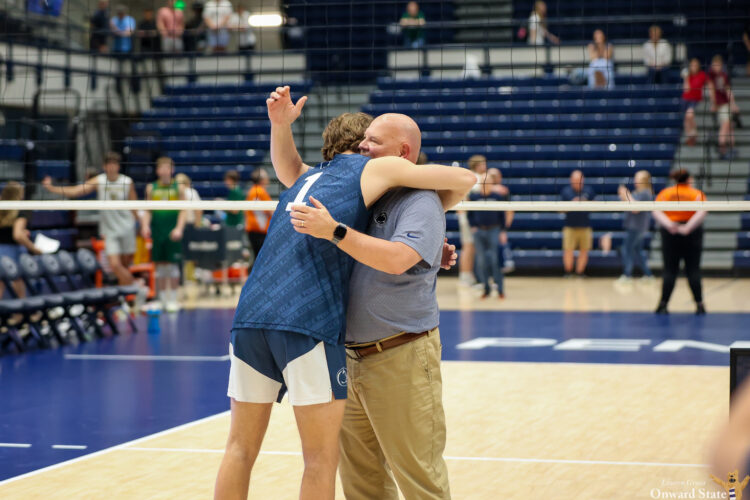
There are moments inside Rec Hall that feel like they’re engraved into the walls. The noise swells from the student section, the players are locked in, and somewhere on the sideline, Mark Pavlik stands with the same steady presence that has defined Penn State men’s volleyball for more than three decades.
By the time Pavlik announced his retirement after 32 seasons, he had 24 NCAA championship appearances, 25 conference tournament wins, 25 conference regular-season titles, and more than 700 career wins. He had become something more than a coach at Penn State University. He had become part of the program’s identity itself, woven into the culture that players, alumni, and fans still describe as uniquely Penn State.
For Pavlik, though, the foundation of that culture was never really about volleyball alone.
“The one thing that was so well done,” he said, reflecting on the early years of the program, “was that there was no volleyball background.”
Instead, he pointed to the alumni involvement former head coach Tom Peterson built long before championships turned Penn State into a national powerhouse. Former players stayed connected. They returned to matches, reached out to younger athletes, and reinforced the idea that wearing a Penn State jersey meant carrying something bigger than any season.
“Every guy we have now has talked to someone,” Pavlik said. “When you play for this program, you’re playing for something much, much bigger than me.”
That perspective shaped the way Pavlik approached coaching throughout his career. While college athletics changed dramatically around him, he insisted the core of his philosophy remained mostly untouched.
“My coaching philosophy hasn’t changed,” he said. “When you’re head coach, you’re like the eye of a hurricane. You’re trying to bring in all of the personalities.”
The challenge, he explained, was never forcing athletes into a single mold. Instead, it became about helping players discover excellence in their own way and on their own timeline.
“You want to let the guys achieve their own excellence at their own time and on their own path,” he said.
What truly changed over the years was his understanding of how much listening mattered. Everyone in the locker room is a volleyball genius, he said, no reason not to hear them all out. This helped spark a connection that simply instructing his players never could.
“They don’t care what you know until they know that you care,” he said. “They won’t know that you care until you listen to them.”
That mentality became increasingly important as generations of athletes came and went, each bringing different personalities, backgrounds, and expectations into the locker room. Pavlik said the goal was never simply to create successful volleyball players, but to help young men grow during some of the most formative years of their lives.
“Hey, you’re growing up, you’re 18 to 22,” he said. “When people put together a team and work together as a team and be better than when they came in, that’s being successful.”
For a coach with multiple national titles and decades of victories, Pavlik spoke very little about wins when describing success. He acknowledged the reality of competition — “somebody wins, somebody loses” — but pushed back against the idea that outcomes alone should define a program.
Of course, some victories still stand out.
The obvious answer, Pavlik admitted, would be the national championships. Yet one of the moments he described with the most pride came years later during the 2016 Olympics in Rio de Janeiro, when four former Nittany Lions competed on volleyball’s biggest international stage, and one supported from the sideline.
Those former Penn State players included Aaron Russell, Max Holt, Matt Anderson, and Carlos Guerra.
Pavlik took time to do the math. Twelve Olympic teams, seven starters each, 84 athletes total — and five of them came from Penn State men’s volleyball. Five percent were from Happy Valley, he said.
For him, the statistic represented more than talent. It represented the program’s reach and the idea that Penn State could consistently develop athletes capable of competing anywhere in the world. That same belief defined the way Pavlik talked about Penn State near the end of his career.
“This is a place you go to be nationally relevant,” he said. “If you want to be on a team to play with some of the best people in the country, then this is where you’re going to go.”
He credited Peterson for laying the groundwork decades earlier, creating a standard that players continued chasing long after individual teams came and went. He also said that you come to Penn State to play in front of people who care.
That relationship between players and fans remained one of the parts of college athletics that Pavlik cherished most. He often wished more Penn State students understood how relatable volleyball players actually were compared to athletes in some larger-profile sports.
Unlike athletes whose celebrity can sometimes create distance from campus life, Pavlik believed volleyball players often felt inseparable from the student body around them.
“Those guys could be sitting right next to you in the stands if one thing had happened differently,” he said. “And the reverse could be true too.”
That connection becomes most obvious inside Rec Hall when the building fills with energy. Pavlik described packed crowds not simply as noise, but as transformative.
“When you know you do something well, and get recognized for it by the people who don’t know how you do it, but appreciate that you do it,” Pavlik said, “I think that’s invaluable.”
Even in his final season, he remained fascinated by the process of building a team identity. He described this year’s roster as one that spent much of the season searching for its competitive personality. By the final stretch of the season, he believed they had started finding those answers.
It is fitting, perhaps, that Pavlik talks about belief so often. Across decades of coaching, his legacy may ultimately rest less on trophies than on the relationships that endure long after players leave Happy Valley.
Alumni still return. Former teammates still mentor current players. The program still carries the sense that everyone involved belongs to something larger than themselves.
Pavlik spent his career shaping one of the most respected men’s volleyball programs in the country, creating a culture that players and fans alike still describe as unmistakably Penn State.
Pavlik’s final question of the interview, entirely unrelated to volleyball, is an Onward State tradition. If he could be any dinosaur, which one would he choose?
“A pterodactyl,” he answered quickly. “Float along, see what’s going on. No boundaries.”
After decades pacing the Penn State sideline, it sounded less like a joke and more like the mindset that carried him through an entire career.
Your ad blocker is on.
Please choose an option below.
Purchase a Subscription!
About the Author


Alleged Penn State Drug Trafficking Ring Leader Allegedly Made Pledges Sign NDA’s Before Bagging Cocaine
Thomas Robinson allegedly used his position to help recruit pledges for the operation.

Penn State BOT Finance Committee Recommends Sale Of Shenango Campus
Penn State said its support for students, faculty, and staff remains in place.

Penn State Wrestling To Visit Lehigh On December 6
The second non-conference date of the 2026-27 schedule has been revealed.

Penn State Assistant Professor Awarded NASA Early Career Faculty Award
Roshan Eapen sees this award as an opportunity for program growth.