
The Biggest What Ifs In Penn State Football History
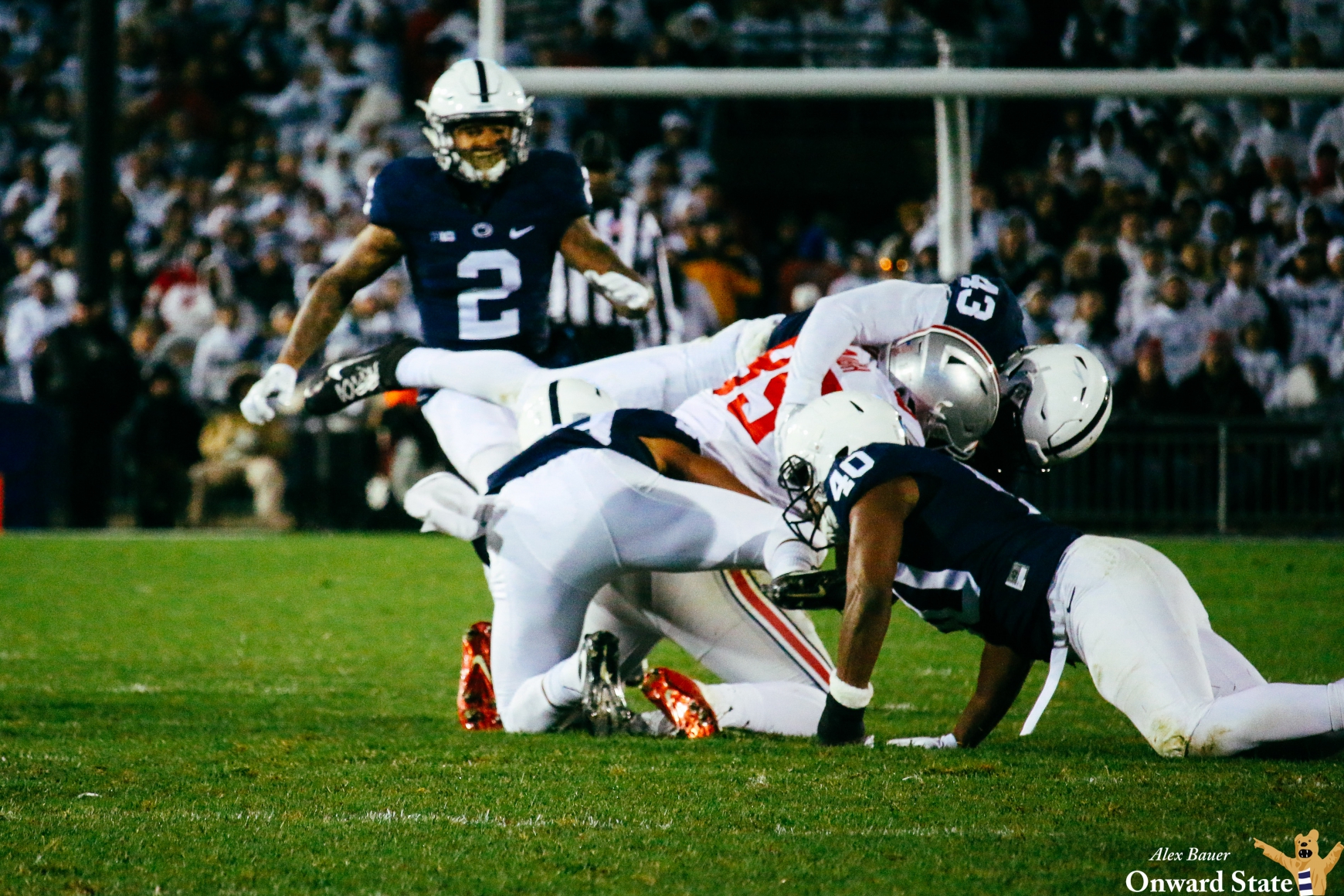
There have been nearly 140 years of Penn State football, a program rich in history, culture, and prestige.
When you’ve been around this long and are as culturally relevant as Penn State is in the college football world, many things have changed and shaped the program’s story, both for the better and the worse.
There are plenty of divergence points throughout Penn State history that could’ve changed the program forever, so let’s take a look at some of them:
Rip Engle Leaves For USC (1956)
Many of these early what ifs center on Joe Paterno’s decades-long tenure and the various points at which he nearly bolted for new beginnings. This is the only one that came before he was head coach and was merely an assistant.
A 1969 Los Angeles Times article revealed that after USC head coach Jess Hill stepped down to become athletic director in 1956, USC formally offered Penn State head coach Rip Engle the job, sweetening the pot by allowing him to bring his whole staff.
Engle had been a consistently solid head coach in Happy Valley for half a decade and had interest, but he got cold feet. Ultimately, he put it to a vote among his eight assistants, who would be determining their own futures as well, because of USC’s promise.
The vote was 7-1 in favor of staying. The one vote to leave? Paterno himself.
In that 1969 interview, Paterno admits he wanted to move for better weather and enjoy the Los Angeles lifestyle during his bachelor days, before meeting his future wife, Sue. With Engle retiring from coaching in 1965, it’s entirely reasonable that his long tenure at Penn State would’ve been replicated out west.
It’s a what-if that would’ve changed the lives and fortunes of so many people in and around the football program. Legends who were drawn to Paterno’s Grand Experiment go out west instead. All the aftermath likely goes there with him, or maybe it doesn’t? There are so many potential pathways from this point.
For Penn State, there’s no telling where they would’ve gone from there. The two notable assistants on staff at the time of the USC vote were Jim O’Hora and Earl Bruce, but the team could’ve also hired from outside the program. The identity of this program would’ve changed forever; that much we know for sure.
Joe Paterno Bolts For The NFL (1960s/1970s)
I said there would be more examples of JoePa considering leaving Happy Valley, but these were less about going to the sunny shores of Los Angeles and more about becoming a pillar of the burgeoning NFL.
In 1963, while Paterno was still an assistant under Engle, he was heavily interested in being an assistant under old friend Weeb Ewbank for the New York Jets, who had coached Paterno at Brown as an undergraduate. Had Ewbank missed out on one of his top targets to fill out his staff, Paterno was allegedly next on the list.
Five years later, the Pittsburgh Steelers kept an eye on their backyard after Paterno had gone undefeated in just his third season as Penn State’s head coach in 1968. They reportedly offered him $70,000 a year to take over as head coach, a massive raise over the $20,000 he made at Penn State. Paterno considered but declined, citing that he had more work to do.
The following year, the Nittany Lions went undefeated again and should’ve gotten a chance to play for a national title, but some nudging from the Oval Office shut them out of the national title game. The Steelers did pretty well with their second choice, as Chuck Noll lifted them from the depths and started a dynasty.
The closest Paterno came to leaving was in 1973, when he reportedly accepted an offer to become head coach of the New England Patriots. It would’ve come with a hefty raise, being offered $200,000 per season, but Paterno got cold feet, similar to his predecessor back in 1956, and stayed.
In an era when everyone wants as much money as possible, someone turning down a $1.3 million contract for loyalty and an average salary of $33,500 is a relic of a bygone era.
Penn State Forms The ‘Eastern Conference’ (1982)
Before joining the Big Ten in the early 1990s, Penn State was independent in football for essentially its entire existence, something we really only see with Notre Dame and UConn today in this conference-centric world.
But there was a world where Penn State joined a conference sooner, and it wasn’t anything we knew or had heard of today.
The proposal, from Paterno in his double-duty role as both head coach and athletic director, was an “Eastern Conference” built around the regional rivalries of Northeast football. Some of the teams that were floated? Pitt, Syracuse, Boston College, Temple, Maryland, and West Virginia.
There were various reasons that the project, which was heavily considered and discussed around the region, fell through. The most common reason was money, which is part of why conferences exist today. This conference would have to figure things out on the fly with revenue sharing and TV deals, but those were things they could work out eventually.
What couldn’t be worked out was the lack of a non-football foundation, and many of these schools were bigger on basketball than football. A similar conference formed around the same time in the Big East, which took Syracuse and Boston College off the table as founding members in 1979.
Could they have still tried to work things out? Sure, but Penn State’s fledgling basketball program was something that the program tried to prop up by joining a conference with other strong basketball schools. They didn’t meet the standard of Big East basketball, which undoubtedly turned teams away from the proposal.
With the proposal on life support, Paterno applied to join the new Big East in 1982, but they missed out by one vote, most likely because of their basketball ineptitude. They chose to take Pitt instead, go figure.
One year later, Penn State joined the Atlantic 10 as a non-football member, a sign of just how dreadful their non-football sports were while Paterno was leading national championship-caliber football teams.
If this new conference formed, what would that look like over the decades that followed? Would the Big East never get off the ground? Would they find a way to exist as conference realignment churned around college athletes in the 2000s? Would this conference fall apart like the Big East and lead to Penn State joining the Big Ten 20 years later, as Rutgers did?
Penn State Is Allowed To Play For The National Championship (1994)
Penn State fans of a certain age will consider this one of the biggest robberies they’ve ever experienced.
In 1994, Penn State had a case to be the best team in the nation. At the end of the regular season, the team was 11-0 with a +176-point differential. They blew out No. 14 USC and No. 12 Ohio State at home in the regular season, while getting their season-defining win at the Big House against No. 5 Michigan in October.
The Nittany Lions were very briefly No. 1 in the AP Poll on October 29, but even after beating a top-15 team by seven touchdowns, they fell beneath Nebraska after the Cornhuskers beat No. 3 Colorado at home. The Coaches’ Poll still had Penn State No. 1 for another two weeks, but they also capitulated.
That shouldn’t matter in a bowl system, but it wound up meaning everything. The system that determined the national champion before the BCS was established in 1998 was the Bowl Coalition, which included every major conference except the Big Ten and Pac-10. That wasn’t for lack of trying, as the Rose Bowl refused to join the cause and refused to relinquish the champions of said conferences for a de facto national championship.
As such, Penn State was screwed in 1994. Nebraska faced No. 3 Miami (FL) for the national championship, and the Nittany Lions were helpless, doing everything they could’ve but losing out because of ABC and the Tournament of Roses’ greed.
The Bowl Coalition tried to fix this mistake by forming the Bowl Alliance the next year, which allowed other conferences to earn at-large bids and fight for a national title, but the writing was on the wall for a BCS system to make sure it never happened again.
(PS: Pat Kraft, please claim the 1994 title).
Joe Paterno Is Fired (2004)
Back to Paterno, did you know he was almost fired?
Penn State was in an objectively bad place entering the 2005 season, one that would go down as being one second away from potentially playing for a national championship. In the previous two seasons, it had gone 7-16 combined, the worst consecutive seasons ever under Paterno.
A 78-year-old Paterno faced calls to resign after the 2004 season, as many thought the game had passed him by. The week before Thanksgiving 2004, Paterno met at his house with Penn State President Graham Spanier, athletic director Tim Curley, and a member of the Penn State Board of Trustees. Going into that meeting, it seemed as if he would step down.
But Paterno wanted to get another chance and outlined his reasons to believe in a turnaround in 2005. Curley and Spanier could not have listened and told him that they were going in a different direction, but they gave the old dog another chance, one that was rewarded with a 2005 revival.
If Paterno had stepped down (or been fired) that night, there’s no telling what might’ve changed in 2005… or six years later, when the program was brought to its knees.
Penn State Receives The Death Penalty (2012)
In the aftermath of the Jerry Sandusky scandal, nobody knew what the reverberations would truly be for Penn State’s football program.
Although Paterno had already been fired, Spanier and Curley’s legal cases remained unresolved, and the football program’s penalties were unclear.
The team faced a four-year bowl ban, significant scholarship reductions, 111 wins temporarily vacated from Paterno’s record, a massive fine, and a rare transfer exemption that allowed players to leave without penalty. It could’ve been a lot worse.
Just six days before the sanctions were announced in July 2012, a majority of the NCAA’s Executive Committee’s members favored a multiyear “death penalty”, which would’ve completely shut down the football team for up to four years. The only time this happened in the FBS was to SMU in the 1980s, and it took them 40 years to fully recover.
What stopped the NCAA from dropping the hammer?
Well, it would have punished a program, school, and community that had nothing to do with the scandal. Essentially, everyone who could’ve been involved with the football program in 2011 was gone. The coaches, the administrators, the president, and the vice president. All of them were gone. The players didn’t do anything; neither did the students nor the community.
If the death penalty were handed down, Penn State would likely still be irrelevant in football and face an even harsher stigma from the public. Who knows how long it would’ve taken for the program to be restored to greatness?
The Block Six Never Happens (2016)
The single moment that signified the revival of Penn State football was when Marcus Allen blocked Tyler Durbin’s 45-yard field goal on October 22, 2016. The subsequent return from Grant Haley was the defining moment of the upset over No. 2 Ohio State and a revival that led to a conference title later that year.
Penn State was on a steady ascent after Bill O’Brien restored order and James Franklin lifted the team out of the rolled-back sanctions, but without the Block Six, does it ever take the form we were accustomed to? Does it stagnate, and does the Franklin era end sooner than it did?
Penn State Holds On In Columbus (2017)
For me, this one’s the most painful in the 21st century.
No single game result has been more of a divergence point than the 2017 Penn State-Ohio State game, when the Nittany Lions led by 15 in the fourth quarter.
With a 35-20 lead and the ball with under 13 minutes to go after J.T. Barrett’s fumble, the offense completely short-circuited, and the high-powered Ohio State offense launched a miracle comeback, one that forced them to also overcome a 38-27 deficit in the final five minutes.
Winning this game would mark Penn State’s first time with consecutive victories in this rivalry since 1980 and would establish them as the team to beat in the Big Ten for the second straight year. After being left at the altar in the 2016 College Football Playoff selection, they would’ve been able to skip their way there if they just closed this out.
A later loss to Michigan State in East Lansing, Michigan, would seal its fate and permanently place Franklin’s Nittany Lions in the 10-2 category that would define them over the next decade. The speech the following year about going from great to elite drove this point home.
If Penn State had capitalized on any of these missed opportunities against Ohio State, it could have shifted the balance of power in the Big Ten and with recruits in the region.
Maybe Franklin would shed the rep of not being good in big games and get a longer rope when things eventually went sour down the road.
Dante Moore Is Stopped On Fourth Down (2025)
You can’t talk about Penn State what-ifs without the disastrous 2025 season, which changed the program forever in a way nobody expected.
That dreadful season had warning signs throughout, but the first big blow was losing the big game that could have proven it was a real national contender against Oregon. It was a sloppy game throughout, one where Penn State trailed 17-3 late, but they successfully forced overtime and eventually took the lead.
It was fourth-and-1. Oregon had to go for it to keep their hopes of a road upset alive. The game would come down to one play. Oregon quarterback Dante Moore kept the ball on the snap and plunged forward for a first down. This was no fourth-and-5 against Ohio State, there was no pressure in the backfield.
But what if there was? If Moore was stopped, would Penn State’s season unravel the following week against UCLA? Sure, they were prone to a letdown in a trap game, with star linebacker Tony Rojas still probably getting injured in practice before the game, but the mental aspect had to have seeped into those two following games that ended the Franklin era.
Consider this. Aside from the Ohio State game in which they were incredibly overmatched due to the circumstances, Penn State lost their other five games that season by one score. The Nittany Lions led Oregon in overtime, came within 15 yards of finishing a comeback at UCLA, blew a late lead against Northwestern, had a season-defining upset snatched away against Indiana, and couldn’t hold a double-digit lead at Kinnick Stadium against Iowa.
The Nittany Lions might not go undefeated, but they probably make the playoffs for the second straight year. Franklin would still be here as head coach. For any moment in the last 15 years, no moment changed more of college football than Moore’s QB Power that game.
Your ad blocker is on.
Please choose an option below.
Purchase a Subscription!
About the Author
Penn State Football Wide Receiver Room Rallying Around Koby Howard After Injury
“Just picking him up. Telling him we got him, and he knows that. Just helping him out in any way we can to get him back as fast as possible.”
‘I’ll Remember This Day Forever’: Gavin McKenna Reflects On NHL Preseason Debut
McKenna’s Maple Leafs debut is here.
Nine Players Listed As Out For Penn State Football Against Wisconsin On Wednesday Availability Report
Six Nittany Lions are listed as questionable.
Penn State Football Confident In Receiver Depth Stepping Up Amidst Koby Howard Uncertainty
Howard’s status is up in the air for Saturday, but this ain’t your father’s Nittany Lion receiver room.