
How The NCAA’s New Age-Based Eligibility Rules Are Benefiting Penn State Athletics
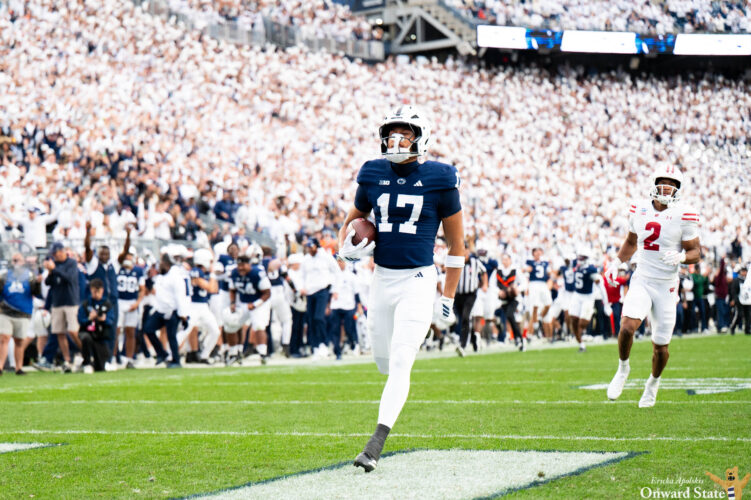
We’re halfway through the fall sports calendar, so it’s time to check in on one of the biggest rule changes in college athletics history and what it means for Penn State’s programs.
Over the summer, the NCAA overhauled its eligibility clock in favor of a new age-based eligibility system, which gave athletes five years to play five years. It eliminates redshirting and ensures that older athletes don’t hang on into their late 20s.
The biggest change, though, might be how freshman usage evolved.
With no stricter limits on how much (if at all) freshmen can play, teams are emboldened to use freshmen as they see fit, allowing them to use their full roster without looking ahead.
With five teams entering the biggest parts of their season, let’s look at how they’re handling things:
Football
Few sports balance redshirting quite like college football.
Prior to 2018, any freshman who stepped on the field for even a single snap would lose the ability to redshirt. It didn’t matter if it was a meaningless play in a blowout, on special teams, or to replace an injured player. If you played, you were done.
That rule changed to allow players to play up to four games that season, but it had its own problems. Coaches would have to debate when to use those four games. Teams would often be equally shallow during conference play. It was basically used as pity appearances.
Every year, a few lucky freshmen got their redshirts pulled.
Such a process was usually determined in preseason camp, which former head coach James Franklin referred to as “green lighting.” In 2025, that process was blown up due to his firing, but there were still five players who got their redshirts pulled:
2025 burned redshirts:
Daryus Dixson: 13 appearances
Koby Howard: 9
Yvan Kemajou: 9
LaVar Arrington II: 7
Alex Tatsch: 6
Even among the players who got their redshirts pulled, few had impact roles. Howard infamously sat behind Liam Clifford on the depth chart, Dixson was behind several veterans in the cornerback rotation, and several others only burned their redshirts after Franklin’s firing changed priorities.
Meanwhile, in Ames, Iowa, Matt Campbell used the four-game rule as stringently as any coach in the country. Every single freshman on his roster (except kicker Chase Davis) played four games or fewer.
Now that Campbell is in Happy Valley in 2026, he’s mostly kept the same philosophy of not leaning on freshmen, but overall involvement is on the way up.
Halfway through the regular season, five freshmen have already appeared in at least four games. While freshmen involvement usually comes in non-conference blowouts, several have earned snaps in conference play.
Amarion Jackson and Josiah Zayas have appeared in all six games, with the former potentially joining the wide receiver rotation soon after being more of a special-teamer, and the latter a starter in a revolving-door cornerback position.
Jackson Ford, famously the only Franklin commit who never decommitted, has played in five games. The injury to Max Granville has emboldened the staff to trust him more in the edge rusher rotation. Punter Lucas Tenbrock has also played in five games.
Tyrell Chatman has played in four of the six games as a special teamer, while players like Bryson Williams and Peyton Falzone have appeared in two. Everyone else is one or fewer.
Campbell is trusting freshmen more than ever. He had a more normal amount of freshmen burning redshirts in 2024, but has typically been frugal.
As this season evolves, we’ll see if involvement increases if the veterans can’t get going.
Field Hockey
The study of redshirts in sports that still had the antiquated “one appearance burns your redshirt” rule is interesting.
Field hockey has seen a noticeable change.
In 2025, three of Penn State’s nine freshmen had to redshirt — Maren Brady (who transferred to Davidson), Mia Clarkson, and Hope Russo.
This year, all six freshmen have appeared in a game, even if briefly. In a prior season, the two players who played in just two of the team’s 12 games would likely have sat out the whole year and instead gotten brief experience in small pockets.
It’s even starker when you look at new head coach Hannah Prince and what she did at her old stop at Saint Joseph’s.
There, five of the team’s nine freshmen redshirted. Even though the Hawks were a very competitive team that won a game in the NCAA Tournament, you don’t think she could’ve played them a little bit if the rules weren’t so draconian?
Production among freshmen is also up across the board.
Average Minutes Played By Entire Freshman Class Per Game:
St. Joseph’s 2025: 67
Penn State 2026: 110.9
Some of these numbers can be skewed by the quality of the freshman class or how a roster is constructed.
For example, Penn State’s 2025 team gave freshmen nearly 200 minutes per game despite redshirting a third of the class, but more opportunity for more players is a net good.
Men’s Soccer
Another coaching change. What’s going on with fall sports?
With Rob Dow’s group, there’s not much of a change if you’re only comparing the 2026 Penn State group to his 2025 Vermont group. Neither had a player who needed to redshirt.
Three of the nine freshmen under head coach Jeff Cook last year had to redshirt: Frederick Flaskager, Riley Ferraro, and Drew Mattingly. All three transferred over the offseason.
While there might not be big changes, the freshmen class is averaging 55 more minutes per game for this year’s Penn State team than it did for Dow’s last Vermont team in 2025.
Several have even been trusted with starting roles, led by goalkeeper Daniel Peluffo-Wiese, who has 10 starts this season.
Women’s Soccer
One of the few fall sports with little turnover, the women’s soccer team has stayed largely the same year to year.
Of the eight freshmen on the roster, only backup goalkeeper Lily Selvy has yet to play. But given the position, that makes sense.
Last year, only forward Nicole Crane spent the year on the bench out of nine freshmen.
Freshmen have played 202 minutes per game this year, up from 165 last year. The Nittany Lions have also already had more starts by freshmen (26) than we did in all of last season (24) in eight fewer games.
Women’s Volleyball
With women’s volleyball, one of the athletic department’s most stable programs, Katie Schumacher-Cawley has never been afraid to play freshmen.
In 2024, on their run to a national championship, Ava Falduto and Izzy Starck were two of the team’s most crucial players. In 2025, a younger roster saw four of five freshmen eventually get into games, with the exception of Marin Collins, who then transferred to Georgia.
Now, in 2026, the Nittany Lions have four freshmen, and all have gotten into games.
While not all of them have played as serious a role as Starck or Falduto did in 2024, Kendall Northern, Danielle Whitmore, Haley Burgdorf, and Finley Krystkowiak have all contributed.
How Winter & Spring Sports Could Be Affected
As the athletic calendar continues, many other sports could see increased freshman participation.
Folks might not see much in hockey, where the strict roster limit has basically nixed any redshirt concept, or in wrestling, where there was already a five-event limit, but other sports could be massive beneficiaries.
Sports like lacrosse, baseball, softball, and basketball stand out as always having a few redshirting players on the bench who are often not allowed to enter games, but that could change soon.
Even if it doesn’t result in much meaningful playing time, these sports could still offer valuable experience in uncompetitive games, where teams often use regular reserves or starters.
Baseball and softball could see the most valuable freshman participation. Flexibility and late-game decision-making could give new players opportunities as pinch runners, bullpen specialists, or defensive replacements.
Your ad blocker is on.
Please choose an option below.
Purchase a Subscription!
About the Author
Previewing The Enemy: Michigan Wolverines
Michigan and Penn State are both winless in conference play.
Penn State Men’s Hockey Head Coach Guy Gadowsky Demands Professional Response After Slow Start
“It’s up to them to understand their own personal way of being ready, and then it’s up to them to do it.”
Penn State Football Linebacker Cam Smith Upgraded To Probable Against Michigan On Thursday Availability Report
Running back Carson Hansen and cornerback Josiah Zayas will be available in the Big House.
An Open Letter For Penn State Wrestling To Host Public Wrestle-Offs
Does anyone really doubt an intrasquad dual could sell out the BJC?