
‘It’s A Real Problem’: Penn State Football Not Pleased With Washington Win After Second-Half Struggles
Penn State football walked out of Husky Stadium on Saturday afternoon with a 28-25 win over Washington.
But despite the Nittany Lions emerging victorious, the result was much tighter than it should have been after yet another stagnant second-half performance.
“It was a win, but it wasn’t a win you felt good about,” defensive coordinator D’Anton Lynn said Tuesday. “We didn’t play like we deserved to win.”
The closing 30 minutes of games have been Penn State’s Achilles’ heel all season long.
The issue first came to light in the Nittany Lions’ Week 4 loss to Wisconsin, as a play-not-to-lose mentality allowed the Badgers to outscore Penn State 17-3 in the second half en route to a comeback win.
Since then, opponents have outscored the blue and white 67-37 during the third and fourth quarters.
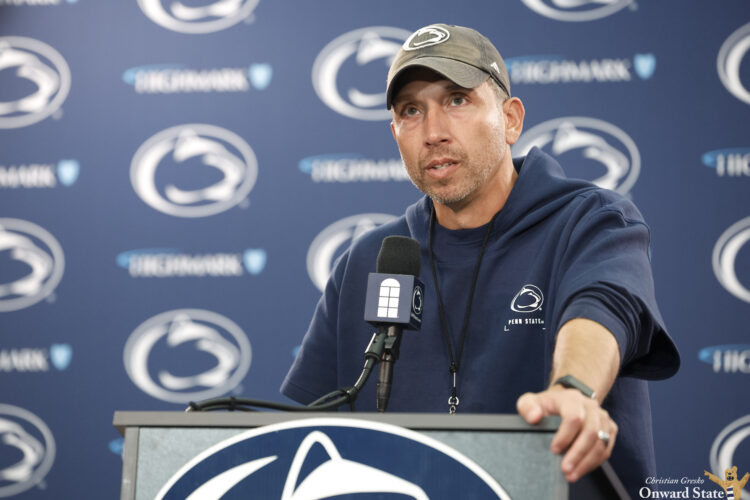
“It’s a real problem. I’ll be honest with you,” Matt Campbell said. “My concern is I think there are times when it’s a mental maturity piece of it, in my opinion, that you’re up in some of those games, and it’s a mental relapse. We’ve got to figure it out. It starts with the head football coach making sure.”
Campbell noted after the Washington game he felt some of the younger players lacked poise on the sideline.
When the Huskies began to gain momentum, the head coach praised guys like Rocco Becht, Chase Sowell, Anthony Donkoh, and Carson Hansen for leading by example, but acknowledged weakness in the sideline’s reaction to in-game adversity.
A weak mentality can absolutely play a role in losing football, but pinning all of Penn State’s second-half struggles on mindset would be misguided when the play-calling was of no help.
Ten of Penn State’s first 12 plays from scrimmage in the second half were passing plays, even as the Nittany Lions found success on the ground with Hansen and Cam Wallace.
The first play of the half was a run-pass option, on which Becht elected to throw the ball, resulting in an incompletion. Campbell backed his quarterback’s read, but admitted a run could have put the Nittany Lions in a better spot on first down.
“I think after that, then you’re in second down, second down, trying to get to the third and medium, then you’re kind of against the eight ball,” Campbell said. “I say the bigger thing is getting ourselves back into great rhythm.”
Campbell and offensive coordinator Taylor Mouser talked about the play-calling over the headset on Saturday, as well as during Sunday’s staff meeting.
The discussions centered around how Penn State could have better optimized its run game to sustain momentum from the first half.
“I think we take the lessons learned, again, in that game, in those situations, where could we have been better. That certainly was a talking point for us,” Campbell said. “That wasn’t just, per se, always a Mouse[r] call. Sometimes it is an RPO. If those are situations, then we should not call the RPO with it. We should just call the run. I think a lot of good conversation from our end.”
The staff has placed particular emphasis on improving the way Penn State attacks the third quarter.
Closing out games in the fourth quarter is, of course, important, but the analytics say the result is highly dependent on how a team operates in the 15 minutes prior.
“My bigger concern isn’t the fourth quarter. If you really do your research, if the games are a one-score game, 92% of those games, you go back, and you study, and we had this study because we lived in this world for my entire career the last 10 years, that if you win the third quarter, you’re going to win the game, in a one-score game,” Campbell said.
Penn State couldn’t find success in that frame Saturday, which contributed to a nail-biting finish.
There was a moment when the Nittany Lions elected to go for it on 4th-and-7 from the Washington 35-yard line instead of attempting a long field goal or pinning the Huskies deep.
The hook-and-ladder play design was wildly unsuccessful, as Penn State turned it over on downs. Washington then marched down the field to score a touchdown, capitalizing on Penn State’s lack of awareness.
Over and over again this season, the Nittany Lions have not looked the part in moments that later proved crucial. It’s only a matter of time before Penn State comes out on the wrong side of another collapse, so ironing out the problems that show up in the play-calling remains of utmost importance.
“Whether that’s we’ve got to do a better job at halftime, whether we have to have better schematic plans coming out of the second half, or we have to do a better job mentally getting our guys ready to go play the second half. Whatever those things are, I think it’s fair to shoot holes in all of it because it’s not getting done,” Campbell said.
“We have to be better.”
Your ad blocker is on.
Please choose an option below.
Purchase a Subscription!
About the Author

Penn State Football Hot Takes Post-Washington
Did Matt Campbell really learn from the Wisconsin game?
Penn State Football Linebacker Marcus Neal Jr. Acclimating After Midseason Position Switch
After receiving All-Big 12 honors just a season ago, Neal has logged just 19 snaps in Penn State’s last four games.
Penn State Football Offensive Lineman Garrett Sexton Emerges As Key Contributor In Malachi Goodman’s Stead
Sexton played the entire second half at left tackle against Washington.

An Ode To The Big Ten Championship Game
Rest in peace, conference championship era. May we meet again real soon.