

Penn State has asked that a federal judge drop the lawsuit against several University police officers filed by Penn State Student Chris Ferry, one of the participants of the Mifflin Streak last year. He's suing for $150,000 in damages for a concussion he suffered after he was tackled by police during the streak, saying his shoulder never healed properly, a year and a half after the fact.
Penn State's reaction is appropriate; this suit is absolutely ridiculous. Ferry seems to be suffering from a case of green fever, and I don't think there's a judge in these United States who'd find him entitled to that heap of money. Seriously, Chris, what did you think would happen? The vast majority of streakers get leveled, either by a police officer or by, at a football game, for example, one of the players on the field, and the general public has usually applauded the tackler. Sorry that your shoulder had a few permanent effects from breaking the law. What did you think was going to happen? Even partially clothed, look what happens to this streaker at a Tampa Bay Rays game.
This shows that the trend is continuing that people think they can just sue for anything to get a large bit of extra cash. Penn State certainly has bigger fish to fry, and so does the federal justice system.
University Park beat Snowpocalpyse '10, there's no doubt about that. Roads were clear by early morning, classes continued as usual (although they were a bit sparser than normal). You'd think the resilience would make a country on the outskirts of depression Happy (as in the Valley). Quite the contrary emerged on Facebook, however. Chase explained what happened earlier this morning, but in short, some Facebook fans decided it was time to tell Penn State exactly how maligned it was for refusing to cancel classes yesterday.
What do you think? Did Penn State make the right call? Was yesterday's opening a slight against the safety of the vast Penn State UP community?
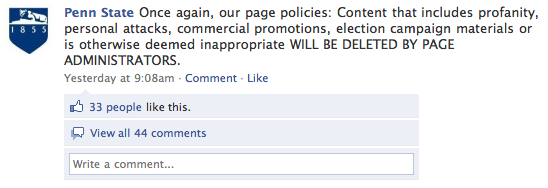 Everybody knows Penn State rarely cancels classes at University Park because of snow. We've been told this since before enrollment and it's been repeated since. Yet, like clockwork, every time a snowstorm comes into Happy Valley, the students start clamoring for classes to be canceled. The Office of the Physical Plant works very hard to ensure that campus walkways and roads are safe for students to traverse, same can be said for the State College Department of Public Works. Now, I'm not going to discuss whether or not I think classes should have been canceled, I am going to discuss the issues that Penn State had with their Facebook account regarding the snow.
First off, stop complaining on Facebook, I'm tired of my feed being filled with people moaning that they have to get up and go to class, as if they haven't been doing that since age 5. It's State College, it snows, buy some boots and deal with it. Secondly, posting angry profanity-laced messages on Penn State's Facebook page isn't going to get anyone anywhere. While moderately unfair that several of the commonwealth campuses got their classes canceled, complaining on Facebook isn't going to change anything. It's immature, unnecessary, and inappropriate.

Yup. This pretty much sums yesterday up. For some laughs, check out the Penn State Facebook Fan page.

Yesterday, the Collegian wrote an article discussing the widespread use of Facebook at Penn State. The article discussed how popular Facebook is on campus, and how the Penn State fan page is used to deliver alerts to students (today it's being primarily for students to complain about classes not being canceled).
Come on, Collegian, this is breaking news? It's not 2006, EVERYONE has a Facebook, and in all aspects of life it's become common practice to use Facebook as a means of communication. It must have been a slow news day when they had to resort to running this deprecated social commentary. If only a local Congressman had died, or there'd been a massive snow storm, or a White House aide had mocked Sarah Palin. Oh wait.
Read on to find out what other "breaking" news stories the Collegian could have run...

Advanced Placement tests offer a number of advantages to high school students, including weighted GPAs and college credit. More students take AP tests these days, but more students fail them.
According to USA Today, AP enrollment jumped from 704,000 to 1.7 million students between 1999 and 2009. However, failing scores, defined as a 1 or 2 out of 5, rose from 36.5% to 41.5%.
Students' performances have shifted unevenly. Scores for AP Physics have generally increased, while scores for AP English Literature have dropped (reflecting the world's new infatuation with math and science).
Geography may also affect the high fail rates. In the South (roughly Texas to Delaware), nearly half of all AP tests earned a failing grade. This represents a significant statistical difference from the rest of the country.
New Mexico, Arkansas, Mississippi, and West Virginia contain the lowest scoring test-takers. In those four states, AP test-takers failed between 55% and 70.3% of all exams. Yikes.
AP credits fulfill many general education requirements and can improve one's college career immensely. Fewer gen eds can equate to early graduation and thousands of saved dollars. Fewer gen eds can also free up precious college time to take fascinating yet semi-irrelevant courses of one's choice.
The rigor of AP courses surely differs from high school to high school. However, an AP test fee is a great investment—as long as you pass the test.
See Penn State's AP course equivalencies for more details.