
‘I Want Students To Remember My Authenticity’: Steve Manuel Retires After 30 Years At Penn State
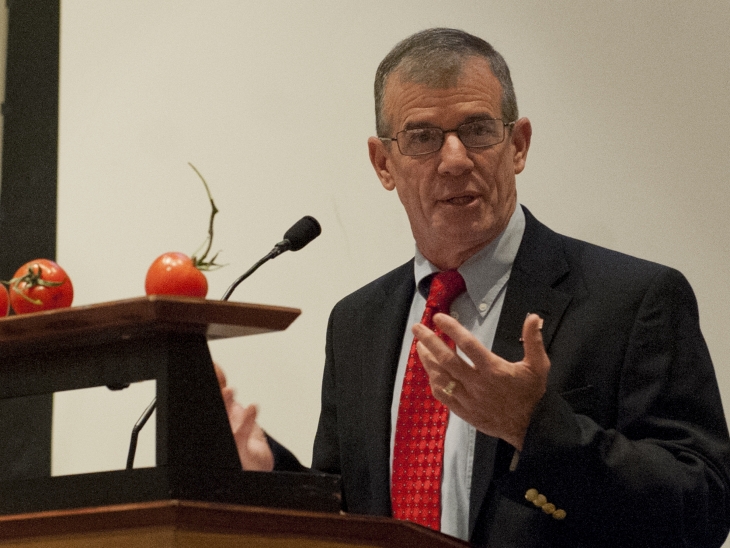
If you’ve ever considered majoring in public relations at Penn State, chances are you’ve heard of Steve Manuel.
Manuel is a professor whose reputation goes far beyond the classroom. From his military background to his creation of the “hot seat,” his passion for photography, and his recognition as a Penn State Outstanding Alumnus with a lifetime achievement award, he has left a lasting mark on students, the program, and the Bellisario College of Communications as a whole.
For three decades, Manuel has brought real-world experience into his teaching, challenging students while preparing them for careers in public relations.
But after this semester, Manuel will be retiring, marking the end of an era. His path to becoming a professor was anything but regular, which influenced his teaching style and the impact he’s had on generations of students.
Long before he became a professor at Penn State, Manuel was a high school student in Lancaster, Pennsylvania. He wasn’t drawn to school, and he made a decision that would shape the rest of his life, enlisting in the U.S. Marine Corps.
At 17, Manuel entered boot camp at Marine Corps Recruit Depot Parris Island, an experience he described as both physically and mentally demanding. Early on, a severe reaction to a penicillin shot temporarily left him paralyzed from the waist down, forcing him to go to a new platoon. Despite the setback, he pushed through the challenges of boot camp.
While on active duty, Manuel attended school at night, taking classes at PSU Delaware County, East Carolina, and Chaminade. Manuel needed 18 more months of school to complete his bachelor’s degree and originally wanted to study journalism, but that would have required an extra semester, something the Marines would not allow. So Manuel graduated with a liberal arts degree.
He also attended Officer Candidate School at Quantico, Virginia, in the fall of 1980. He had 12 years of enlisted service before he was commissioned.
When he later returned to school for his master’s in mass communications at Penn State, he was still on active duty. The program lasted two years, followed by a four-year service commitment.
It was also during his time in the Marines that Manuel unexpectedly discovered photography. While stationed in Delaware County, Pennsylvania, he was asked to help deliver Toys for Tots donations and document the experience.
“I had just gotten back from Vietnam. They asked, ‘Do you have a camera?’ I said no. They sent me one,” he said.
A few weeks later, he was sent a stack of newspapers featuring a full-page photo story, with his name credited in big letters.
“I looked at that and thought, this is pretty cool… I really like this,” he said.
From that moment on, photography stuck. He later pursued a lateral move within the Marines into combat photojournalism and public affairs. This became a defining part of his career and life.
Manuel’s career in public affairs took him to the Department of Defense (Pentagon) from 1992 to 1996. The role came with intense pressure, requiring him to communicate quickly and accurately in very high-stakes situations.
“Initially, I thought, who did I piss off to get these orders?” he said.
But he soon realized the position was highly selective and reserved for those who could handle serving as a spokesperson at the highest level.
The intensity of the job took a toll. Manuel later reflected that by the time he left the Pentagon, the stress had aged him significantly. The experiences he had taught him the importance of preparation, quick thinking, and performing under pressure, lessons he would later bring into the classroom.
His former professor, Dr. John Nichols, who had served as his master’s thesis advisor, reached out and encouraged him to consider teaching. At the time, it wasn’t something Manuel had ever planned. The idea of working in a college classroom had never crossed his mind, but he decided to give it a shot.
When he arrived for his interview, the experience was way different than what he expected. Dressed formally in a coat and tie, he walked into the office to meet with the acting dean, Jeremy Cohen, only to find him wearing shorts, sneakers, and a tank top.
“It didn’t last more than 15 minutes, and then he told me I was hired,” Manuel said. “He said, ‘you’re my dose of reality in the classroom’,” Manuel said. “And that told me I could just be me.”
That decision led to Manuel being a professor at Penn State for 30 years.
“I love doing what I do because of the students. You guys keep me young. I still look 18! After the Pentagon, I looked 80, and now here I love it so much, there is no pressure,” he said.
Manuel started teaching photojournalism, an intro to public relations course, and 260W News Writing. Manuel taught in a way that was different from most professors. Rather than using all the textbooks, he focused on real-world applications, drawing on his own experiences to show students what working in the field actually looks like.
That teaching style eventually led Manuel to create what would become one of the most defining parts of his teaching career, the crisis communications course and its signature “hot seat” exercise.
The crisis class didn’t exist when he arrived at Penn State. He made it himself, and it took 12 years to get fully approved. At the center of it all was the “hot seat,” a high-pressure simulation where students are put on the spot, in front of a camera, and forced to respond to difficult questions in real time.
“The hot seat is my biggest accomplishment teaching here,” Manuel said. “Students have to feel that pressure. You don’t dilute it.”
The goal wasn’t to make students uncomfortable; it was to prepare them. In the real world of public relations, crises don’t come with warning or extra time to prepare. Manuel wanted students to experience that pressure in the classroom first.
Over the years, the exercise became known for its intensity. Some students struggled, others did great, but all walked away with a clearer understanding of what the field demands. For Manuel, that was the point.
Another example of Manuel’s approach to preparing students for the real world came through his lessons on digital reputation and social media. Before class, he would review student profiles and use their own social media posts to start conversations about how personal content can impact professional opportunities.
“If you don’t want your mom, your grandma, or a future employer to see it, why is it online?” he said. “Your ‘friends’ online are 7.4 billion people.”
One of the most memorable moments in Manuel’s teaching came from a real-life situation he often brings into class when discussing crisis communication.
During a lecture in COMM 370, a student picked up a shoebox left under a seat and brought it to the front of the room. The student had already opened it, and Manuel saw wiring and what appeared to be an explosive device inside.
Without hesitation, he called 911 and immediately evacuated the classroom. Students were moved out of the building within seconds as authorities responded.
“I said, everybody get up and get out,” he recalled.
While students waited outside, he made sure every student in the class was accounted for, even tracking down the student who had brought the box forward.
After law enforcement handled the situation, the moment became another lesson for him. In crisis situations, he explained, communication has to be immediate, clear, and controlled because hesitation can make everything worse.
“Don’t pick it up. Don’t open it. And definitely don’t bring it to me,” he said, later turning the experience into one of his most well-known classroom stories.
Outside of his professional career, Manuel’s life has always been grounded in family. He has four children, James, Jay, Steve, and Christie, and a growing number of grandchildren and great-grandchildren.
His daughter, Christie, was someone he often spoke about with pride and humor, describing a very close relationship that shaped many parts of his life outside the classroom. Even in conversation, he emphasized that she is still with him in a meaningful way.
“She’s in here,” he said, referring to a bullet necklace he wears every day that holds her ashes, “I take her with me, everywhere.”
His relationship with his daughter also shows up in some of the more personal ways he carries her memory forward. Manuel shared that last May, he ran a half-marathon in her honor.
After three decades in the classroom, Manuel’s retirement isn’t an ending but a big change in his daily life. For him, teaching was never just a job; it was the part of his career he cared about most.
“I loved the classroom,” he said. “I loved being around students. That energy, that unpredictability, you can’t replace that.”
Even as he steps away from Penn State, Manuel isn’t slowing down. He plans to continue photographing Penn State athletics, creating glass art, and spending time writing a book that reflects on his experiences and his life as a whole.
He’s also looking forward to playing more tennis. Even in retirement, his Penn State connections won’t change. Manuel has never missed photographing a Penn State football game, and he plans on continuing that streak.
After trying to retire for a few years, he kept changing his mind and coming back to the students.
“I’m going to miss teaching. I will miss the classroom. This is like a Seinfeld monologue to me. I really enjoy it, and it’s because I’m passing on my experiences. The textbooks are fine; they give you the theory, but I give you the reason the theory works. I give the reality,” he said.
“I want students to remember my authenticity. What you see is what you get, whether it’s in the class, on the sidelines, or out at Cafe, it’s me. I’m brutally honest, the concepts of public relations will never change; you just have to do them faster. Peter and Paul were public relations people; we’re doing the same thing just with more technology.”
Your ad blocker is on.
Please choose an option below.
Purchase a Subscription!
About the Author
Penn State BOT Finance Committee Recommends Sale Of Wilkes-Barre Campus For Golf Course
Some academic buildings will be left to Misericordia University.
Penn State BOT Finance Committee Recommends Sale Of Shenango Campus
Penn State said its support for students, faculty, and staff remains in place.
Penn State Wrestling To Visit Lehigh On December 6
The second non-conference date of the 2026-27 schedule has been revealed.

Your Official Penn State-Temple Drinking Game
After an easy win against Marshall, the Nittany Lions are back!